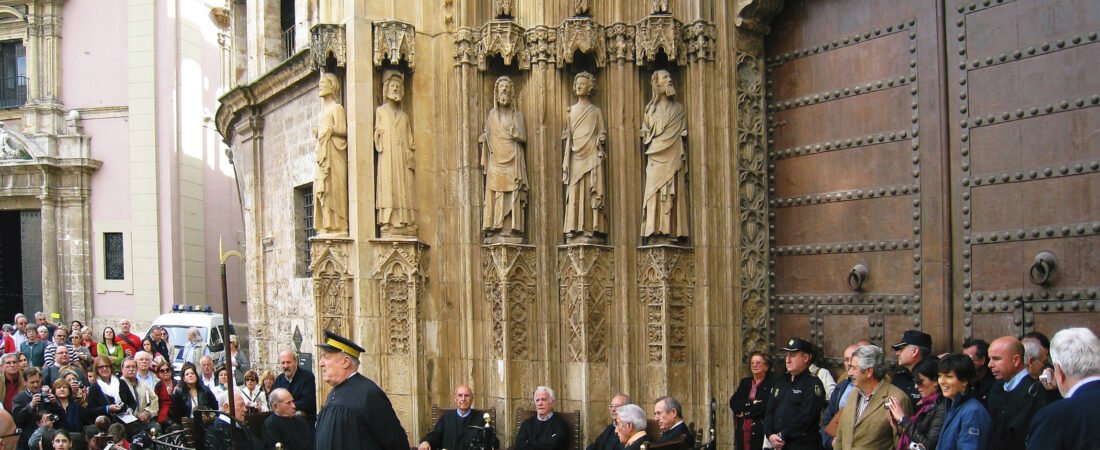
Imagine arriving at Valencia Cathedral just before noon. You have been looking upwards — at carved stone, at figures above the doorway, at all the things a visitor is supposed to admire. Then you notice the chairs.
For a few moments, the most interesting thing in the square is happening at ground level.
The Tribunal de las Aguas, or Tribunal de les Aigües in Valencian, meets at the Apostles’ Gate. Its business is water: the shared resource on which the surrounding agricultural landscape depends. Come expecting a grand spectacle and you may miss what makes it remarkable. Come with a little context, and an ordinary doorway becomes a place where the city’s relationship with the land comes into view.
The invisible landscape behind the cathedral
A visitor can spend days in Valencia thinking about food without thinking very much about irrigation. We admire market stalls, order lunch and photograph the result. Somewhere beyond that pleasant sequence lies a harder question: who gets the water that helps make the harvest possible?
The tribunal deals with disputes involving irrigation in the huerta, the agricultural landscape around Valencia. The University of Valencia describes complaints concerning water distribution, irrigation damage and the condition of channels.
Think of a shared channel as a promise between neighbours. What happens upstream matters downstream. One person’s decision can reach someone else’s field before either of them has exchanged a word.
That is why the subject is bigger than it first sounds. Water carries the possibility of a crop, the value of someone’s labour and the need to trust the people beside you. A dispute about its use can become a dispute about whether living together is working.
What actually happens at the Water Tribunal?
According to the tribunal’s own account, eight syndics sit in places associated with their irrigation channels. The bailiff calls for those with cases. Where a complaint is heard, the parties speak for themselves, and proceedings take place orally in Valencian.
The institution lists practical causes of disputes, including taking water out of turn, damaged channels and excess water harming a neighbouring field. These are working concerns, not historical scenes performed for visitors.
An interesting detail: the bailiff carries a two-pronged brass implement. Its form comes from a tool used to handle boards in water dividers. An object connected with the work of irrigation has become a sign of the court’s authority.
Look at it with that in mind. A ceremonial object can seem remote until you discover the practical job behind its shape. Suddenly it belongs to hands, channels and everyday labour.
You may also notice how little the setting separates the institution from the street. The cathedral doorway supplies a magnificent backdrop, but the subject under discussion belongs to the fields.
How old is it? The mystery deserves an honest answer
You will encounter confident claims about the tribunal’s age. The more interesting answer leaves room for uncertainty.
The University of Valencia notes that the institution is documented from the Middle Ages, while its precise origins remain unknown. Its history is closely connected with the irrigation system, and the oral nature of its earlier proceedings makes a detailed reconstruction difficult.
There is a real mystery here, without the need to add a hidden founder or an exact birthday that the evidence cannot securely provide. Some institutions leave their history in buildings and papers; others depend heavily on habits, spoken knowledge and people teaching the next generation what to do.
Imagine trying to reconstruct centuries of conversations from the few traces they leave. The gaps do not make those conversations unimportant. They make certainty harder.
Why UNESCO recognised it
In 2009, Valencia’s Water Tribunal and Murcia’s Council of Wise Men were jointly inscribed on UNESCO’s Representative List of the Intangible Cultural Heritage of Humanity.
The recognition concerns a living practice: community knowledge, oral procedures and ways of resolving disagreement. It helps explain why a short encounter outside a doorway can matter as much as an elaborate monument.
A stone façade can survive while nobody remembers how it was made. A practice needs people to keep doing it. The people sitting in those chairs are part of what makes this heritage visible.
Why your visit might be surprisingly brief
Do not plan your morning around a guaranteed dramatic argument. Cases depend on actual complaints; the tribunal’s description explicitly allows for the possibility that nobody is called to answer one. A session can be brief.
If you are used to attractions designed to fill a time slot, that may feel unexpected. But a quiet day has its own meaning. You have come to see an institution carry out its business, and its business does not expand to entertain an audience.
Give yourself permission to find that interesting. Watch how the meeting occupies the doorway, how the audience gathers and how quickly an ordinary square can recover its everyday rhythm.
How to see the Water Tribunal in Valencia
Where: the Puerta de los Apóstoles, or Apostles’ Gate, at Valencia Cathedral beside Plaza de la Virgen.
Usual time: Thursday at 12 noon. The tribunal advises that public holidays can alter the schedule, often moving the session to Wednesday. Check its official visitor information and current announcements before setting out.
Tickets: none are required to watch the public session. Ordinary attendance does not need a reservation. The institution’s separately arranged educational group visits are a different activity.
Our suggestion is to arrive a little early, keep the entrance and participants’ paths clear, and put your phone on silent. If you do not understand Valencian, knowing the purpose of the gathering beforehand will help you appreciate what you are watching.
Make it part of a slower old-town morning
Use the session as an anchor for your walk, rather than trying to squeeze it between tightly timed bookings. Leave room afterwards to look at the cathedral exterior and explore the surrounding streets.
A useful question to carry with you is: what keeps this city alive? The buildings are the visible answer. The water, work, customs and agreements behind them are another.
For more discoveries close at hand, read our tiny secrets of Valencia. If you enjoy seeing familiar streets transformed by tradition, meet La Moma and the seven deadly sins. Or follow our story-led old-town walk to build a fuller morning.
Sources and photograph
Visitor arrangements and procedural details: the Water Tribunal’s official visitor page and account of its operation. Historical uncertainty and irrigation context: University of Valencia. Heritage recognition: Spain’s official tourism portal. The opening scene is imagined; reflective passages are our interpretation.
Featured photo: Valencia Water Court by Martinvl, Wikimedia Commons, CC BY-SA 3.0. Original uploaded without edits; website previews may resize or crop the image.

Discover the stories between the landmarks
Our Valencia Local Guide brings mapped stops and audio stories to your own old-town walk. Explore at your pace, pause when something catches your eye and keep discovering after the tribunal has finished.
The public tribunal session is free and independent of the guide. Use our pocket companion for the wider city walk, and check the tribunal’s own announcements for your visit.
The next time you photograph the cathedral, you may find yourself looking at the space in front of it, too.