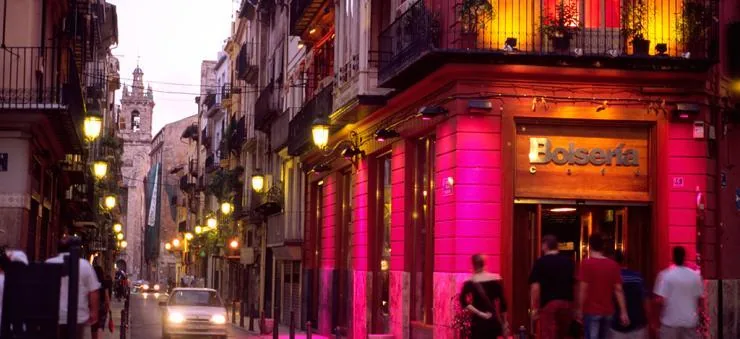
Walk through a medieval gateway. Follow the merchants into a forest of stone. Turn a corner and find a whole square hiding inside a circle. Valencia rewards the traveller who pauses.
There is a moment on almost every city walk when the map stops being useful. It can tell you where you are. It cannot tell you why the doorway beside you feels important, what a strange figure above the street is doing there, or why everyone else has hurried past something you cannot stop looking at.
That is where this self-guided walk through Valencia’s old town begins: with the things worth noticing.
The route connects Serranos, San Nicolás, the Silk Exchange, the Central Market, Plaza Redonda and the cathedral quarter. Follow it slowly, take the detours that interest you, and let the city become more than a collection of photographs.
Plan your walk: allow roughly half a day if you want time for stops, food and selected interiors. That is a suggested pace, not a fixed tour duration. You can also enjoy the streets and façades in a shorter walk.
A note from us: Hidden Valencia is a discovery journal by Travel to Valencia. The Valencia Local Guide mentioned below is our own paid digital guide, with a free sample you can try first.
1. Torres de Serranos: begin at the threshold
Stand outside the Serranos Towers before you pass towards the old town. Give the gateway a moment to make its impression. The opening is human-sized; the architecture around it is not.
Built between 1392 and 1398 under Pere Balaguer, the towers were part of Valencia’s medieval defences. Today the surrounding city is open, but the entrance still carries the weight of a boundary. Once, arriving here meant approaching a city that could close its doors.
Look at the difference between walking towards the towers and walking away from them. From one direction, Valencia seems guarded. From the other, the streets begin to draw you in. A few steps change the entire scene.
Your first discovery: compare the outer face with the side facing the city. Do not let a single photograph become your whole understanding of the building.
This is also where you can get a taste of our pocket guide. Open Valencia Local Guide and choose “Try your guide free” to hear the prepared Serranos story before deciding whether the full experience suits you.
2. San Nicolás: a reason to look above eye level
Continue into the old town towards San Nicolás on Carrer dels Cavallers, also known as Calle Caballeros. The pleasure of this part of the walk lies in the changing scale: substantial façades, narrow openings and small glimpses into spaces you did not expect.
Inside San Nicolás, Gothic architecture meets Baroque frescoes. The painted vault is the great surprise. The building asks for a different way of looking: upwards, slowly, allowing your eyes to move from one scene to another instead of trying to absorb everything at once.
Outside, the street continues with its ordinary business. Inside, the ceiling seems to have opened into another world. That contrast is part of the experience.
Make it work for your day: the cultural visit is ticketed and has its own timetable. Mondays are currently reserved for worship rather than tourist visits. Check the church’s official visitor hours before arranging your route around the interior.
3. La Lonja: when trade built a palace
Head towards La Lonja de la Seda, the Silk Exchange. If you decide to enter, pause in the great trading hall before reaching for your camera. Its twisting columns draw the eye upwards, giving a place of commerce an almost ceremonial gravity.
UNESCO dates the complex to 1482–1533 and recognises it as an exceptional example of late Gothic architecture. Its original purpose was trade. The grandeur speaks of a city whose merchants wanted their business to occupy a building worthy of its importance.
Think of how differently a deal might feel beneath a ceiling like this. The room makes an argument before anyone has said a word.
Look closer: choose one column and follow it with your eyes from the floor to the vault. Then look across the hall. Repetition turns a single piece of craftsmanship into an entire atmosphere.
4. Mercado Central: the city that still needs lunch
Across the market area, the walk changes register. After the solemnity of stone, Mercado Central brings you back to appetite.
Here the discoveries are immediate: a colour you want to photograph, something you would like to taste, a counter that makes you stop. The building is a monument, but the market is also a working place. People are shopping for meals, not merely passing through a visitor attraction.
Let that ordinary life become part of your visit. Leave space for customers, ask before photographing people closely, and buy something that catches your interest. A modest purchase can become a more vivid memory than another hurried photograph.
Timing matters: the market normally opens Monday to Saturday and closes at 15:00. Aim for the morning and check holiday arrangements. If it is the main reason for your walk, visit it first and adapt the rest of the route around it. See the official market information.
5. Plaza Redonda: step out of the street and into a circle
From the market area, continue towards Plaza Redonda. Its entrance is part of the charm: the surrounding streets do not prepare you for the shape waiting inside.
Designed in the nineteenth century by Salvador Escrig, the square forms a circular enclosure. Four entrances connect it with the irregular streets around it. Step in and the city briefly rearranges itself around you.
Look up from the shopfronts towards the balconies, then back towards the centre. You have been walking through corridors of streets; suddenly you are standing inside a room with the sky for a ceiling.
A small walking game: leave by a different entrance from the one you used to arrive. Notice how quickly the familiar city can feel unfamiliar when you change your angle.
6. The cathedral quarter: where certainty gives way to curiosity
Continue towards Plaza de la Reina and Valencia Cathedral. This is a good point to slow down again. A major landmark can tempt you into treating the whole area as a single stop, when its edges are often just as interesting as its centre.
The cathedral preserves the Holy Chalice, associated by religious tradition with the Last Supper. The object’s documented presence in Valencia since 1437 and the belief attached to it are different kinds of history. One does not require you to pretend that every question about the other has been settled.
That is part of what makes the story compelling. You can be interested in the craftsmanship, the journey of a relic or the devotion it inspires. Curiosity does not demand that everyone arrive at the same conclusion.
Walk around towards Plaza de la Virgen rather than immediately leaving for the next landmark. Find a place to pause. By this point, you have crossed several versions of Valencia: the defended city, the trading city, the everyday city and the city of sacred stories.
For a deeper look at its stranger chapters, read our Dark Secrets of Valencia: 8 True Stories & Local Legends.
How to turn a pleasant walk into your own discovery tour
The route above is yours to follow without buying anything. If you would like more context as you go, our Valencia Local Guide puts prepared stories and mapped stops on your phone.
Open a stop, listen to its story, then look at the place again. Something that seemed like decoration may become the detail you remember. When another question occurs to you, you can ask it or submit a photo question through the guide. Interactive answers use AI; the prepared audio stories are available alongside them.
You do not need to download an app or meet a group. Stop for coffee, spend longer in a square, or return to the walk later while your access remains active. Your access period begins when you activate the guide, rather than when you buy it.
Choose the amount of exploring that suits you: SHORT covers 10 essential stops plus a bonus, with 24-hour access. STANDARD and VIP cover 30 main places plus a bonus, with 48-hour access. All include mapped stops and prepared audio; question allowances and spoken interactive answers vary by plan. Check the live guide page for current prices and features.
The route in this article is an introduction to the old town, not a complete list of everything in the guide. You can use the mapped stops to choose what comes next.
Walking with children? Give them something to discover
A child may not be interested in the date on a plaque. A tiny doorway, an animal above a market or a fountain full of figures is a different proposition.
Our guide includes an optional seven-discovery family game in every Valencia plan. Families follow clues, look closer and choose answers together. It is designed to be played with an adult, with hints and the freedom to skip a discovery or take a break.
Let the child become the person who notices something first. That small change can turn another walk through an old town into a shared investigation.
A few practical details before you start
Bring: comfortable footwear, a charged phone, mobile internet access and headphones if you want to listen without disturbing others. Carry water and make room for breaks.
Plan interiors separately: the digital guide does not replace admission tickets, reservations or venue opening hours. Churches may restrict tourist visits during worship. Tower climbs and some historic interiors involve stairs; choose the stops that work for your group.
Be flexible: the street route can still be rewarding when an interior is closed. Avoid planning every minute around a doorway being open.
Sources and further reading
Historical details were checked against Cultural València’s Serranos information, San Nicolás, UNESCO’s Silk Exchange listing, the regional tourism description of Plaza Redonda and UPV’s research listing on the Holy Chalice. Guide features were checked against our live product page when this article was prepared.
The next story is already in your pocket
You can leave Valencia with photographs of its buildings. You can also leave remembering why you stopped, what surprised you, and the small detail you would have missed if you had kept walking.
Start with the free Serranos sample. If you enjoy discovering the city this way, choose your Valencia Local Guide and keep exploring at your own pace.
Take your time. There is more here than the map can tell you.