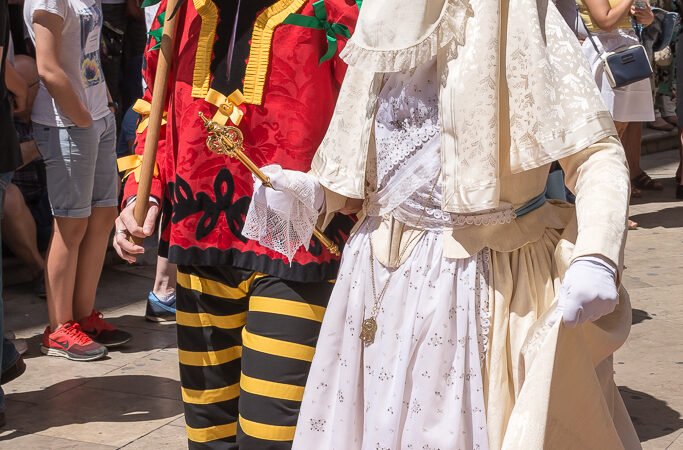
Imagine turning a corner in Valencia’s old town and finding yourself face to face with temptation.
It has a mask. It carries a stick. And it has brought six companions.
Among them stands a figure in white. If you arrived without knowing the story, you might reach for your camera and wonder what strange character had wandered out of an old painting. Stay a little longer. You are watching La Moma, one of the most intriguing traditions of Valencia’s Corpus Christi celebrations.
The secret is in knowing who is who. Once you do, a colourful dance becomes a small drama about the things human beings find hardest to resist.
Who is La Moma?
La Moma represents Virtue. The seven Momos represent the seven deadly sins. In the dance, they try to overcome her; she ultimately prevails. The white costume belongs to an allegorical character within a Christian celebration.
That knowledge changes the scene. The figures become ideas with bodies: something you can follow with your eyes instead of being asked to picture in your head. The suspense comes from watching the encounter unfold, even when you know how it ends.
There is room for mystery here without inventing a haunting. The covered face, the contrast between costumes and the feeling of stepping into an unfamiliar visual language are quite enough.
Meet the seven companions
The familiar Christian list is pride, greed, lust, envy, gluttony, wrath and sloth. Rather than memorising seven names, think of them as seven ways to lose your balance.
Pride is the voice that cannot bear to be wrong. Greed keeps reaching after it has enough. Envy counts somebody else’s blessings and turns them into a personal wound. Wrath wants the last word, however much damage it does on the way.
The old words may sound remote from a holiday in Valencia. Their pull is easier to recognise. You can encounter envy over a phone screen, pride in a small argument, or greed in the conviction that one more possession will finally be sufficient. These are modern reflections on the symbolism, rather than additional scenes in the choreography.
Perhaps that is the dance’s most unsettling quality: you can stand safely in the audience and still recognise something of yourself among its characters.
Three details that change how you watch
Look for the leader. Antonio Atienza Peñarrocha’s historical study identifies Pride as the leading sin in the dance. It is a wonderfully revealing choice: the impulse that believes itself above correction at the head of the trouble.
Watch the sticks. The confrontation is theatrical, with temptation and simulated blows forming part of the action. Read the movement as a story, rather than a real fight.
Remember the performer behind the costume. The same study records a tradition of a man playing the female figure of the Moma. It is a detail of the role’s performance history that a photograph alone will not tell you.
Try watching one complete sequence before looking at your camera. Who draws your attention first? Who seems to control the space? What happens to your impression when you remember what each figure stands for? You do not need to decode every gesture to enjoy looking more closely.
A medieval celebration — with a history of change
Valencia’s Corpus procession is traced to 1355. Its world extends beyond this one dance: giants, large-headed figures, biblical characters and fantastic creatures all belong to the celebration’s rich cast.
The Rocas are the grand ceremonial carriages associated with the festivities, carrying religious scenes. Imagine the effect of seeing that whole visual world move through familiar streets: scale, colour, belief and public spectacle sharing the same space.
Yet an old festival does not mean that every detail has stayed untouched. Atienza Peñarrocha describes changes in the Moma tradition and its revival in 1977, drawing on remembered music and surviving dance outlines.
That may be the most moving part of its story. A dance needs people willing to learn it. A costume needs someone to care for it. Memory becomes fragile when nobody takes the next turn.
When we call a tradition ‘living’, this is what the word asks us to notice: the work of keeping it alive. Behind the mysterious figure are rehearsals, skill and people who decided that the next generation should be able to see it too.
What Corpus Christi means beyond the spectacle
Corpus Christi is a Catholic celebration honouring the Eucharist. Its striking characters and public performances belong within that religious setting. Visitors can appreciate the artistry and symbolism while respecting the devotion behind them.
The regional tourism description evokes pipes, dance groups, giant heads, the Miguelete’s bells and flowers scattered from balconies as the Custodia passes. It is a celebration experienced through sound and movement as much as through sight.
If you attend, give the performers room, follow the stewards’ directions and remember that a procession is also an act of worship. A good view is worth waiting for; it is never worth stepping into someone else’s path.
Can you discover this tradition outside the festival?
Yes. Put the Museo del Corpus – Casa de las Rocas on your list. This dedicated museum offers a way into the festival’s world when the streets are following their everyday rhythm. Check its official visitor information for current opening arrangements.
Treat it as an invitation to slow down. Choose a detail that puzzles you and read its explanation before moving on. A museum visit can turn unfamiliar festival objects into something you recognise the next time you see a procession photograph.
For a live performance, consult the current Corpus Christi programme. The festival moves with the religious calendar, and individual dances and processions have their own timings. La Moma is not a daily street attraction.
A small challenge for your next old-town walk
After learning this story, look for one figure in the city that you cannot immediately explain. It might be an animal carved above a doorway, a saint with an unfamiliar object, or a face tucked into a façade.
Before searching for an answer, take a guess. Then find out what it means. The difference between your first impression and the real explanation is often where the pleasure begins.
For more places to practise, explore our six tiny secrets most visitors walk past, or follow our story-led walk through Valencia’s old town.
Sources and photograph
Historical details are drawn from Antonio Atienza Peñarrocha’s La danza de la Moma del Corpus de Valencia. Festival context comes from Valencia Turismo and Comunitat Valenciana tourism. Our imagined opening and reflections are storytelling, not an eyewitness account.
Featured photograph: La Moma i els Momos, Valencia, 2016, by Heidi Donat (StellarD), via Wikimedia Commons. Licensed CC BY-SA 4.0. Original uploaded without edits; website previews may resize or crop the photograph.

Keep discovering Valencia, one story at a time
Once a figure in a procession has a meaning, the city feels a little less anonymous. The same can happen with a tower, a square or a doorway you nearly walked past.
Our Valencia Local Guide is a pocket companion for exploring the city at your own pace, with mapped stops and audio stories. Use it to continue your old-town discoveries before or after a museum visit; festival schedules and admission arrangements remain separate.
Next time the figure in white passes through the crowd, you will know who she is — and why her seven companions cannot have the last word.