Imagine walking into Valencia Cathedral carrying a story you already know: a lost cup, a dangerous journey, a mystery that generations have tried to solve.
Then you find yourself looking at something small enough to hold in your hands.
The Santo Cáliz, or Holy Chalice, is venerated here as the cup of the Last Supper. To a believer, it may be an object of profound devotion. To a curious visitor, it raises a question that is difficult to leave at the chapel door: could this really be it?
The most rewarding way to explore the Holy Grail of Valencia is to follow three threads: the object itself, its recorded history and the tradition attached to it. Each tells you something different. None needs to be disguised as another.
First, look past the gold
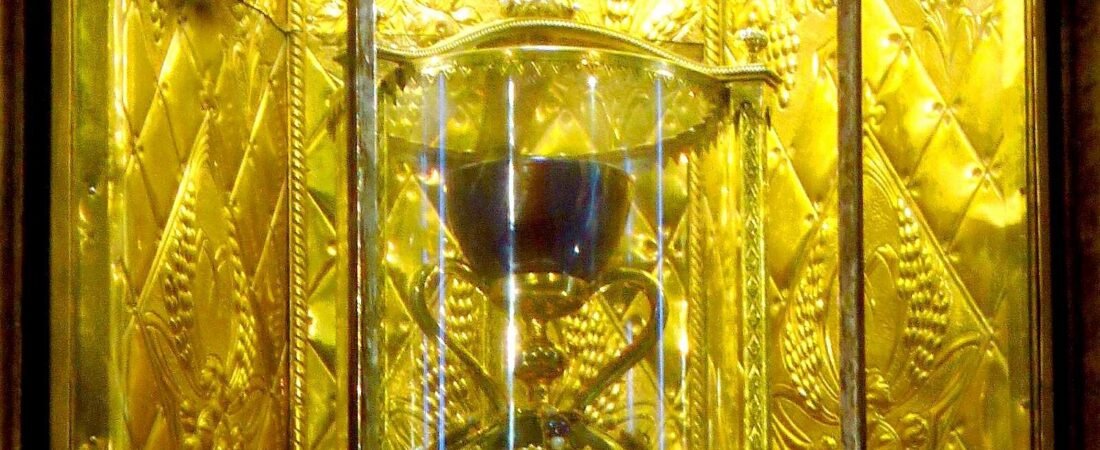
The elaborate setting catches the eye. Yet the part at the heart of the claim is the upper agate cup. The cathedral describes it as an ancient vessel, with medieval handles and a base.
That is your first discovery. What appears to be one object contains different moments in time.
Think of the precious setting as a later expression of the importance given to the cup. The question about the Last Supper concerns the stone vessel above it, rather than the complete decorated chalice as you see it today.
Try separating those parts with your eyes before reading more. The mystery becomes easier to understand when you know exactly which object is being discussed.
What can the stone tell us?
The cathedral dates the agate cup to the first century BC. Researchers have examined the case for an ancient origin, and a Universitat Politècnica de València account of Manuel Zarzo’s work carefully describes its connection with Jesus as a hypothesis. It also distinguishes the upper cup from its medieval supporting elements.
An ancient date would make a vessel compatible with the period of the Last Supper. It would not, by itself, identify the person who used it. Those are different questions.
Imagine finding an old key. Its material and shape might help establish when it was made. Knowing precisely which hand turned it, and in which lock, would require another kind of evidence.
You can take the research seriously while recognising that distinction. It makes the mystery more interesting, because it tells you where the evidence ends and the larger claim begins.
The journey told by tradition
According to the tradition presented by the Holy Chalice Foundation, Saint Peter took the cup to Rome. Later, during persecution under Emperor Valerian, Saint Lawrence helped send it to Huesca in Spain for safekeeping.
The traditional account continues through hiding places in the Pyrenees and connects the relic with the monastery of San Juan de la Peña. These early stages should be understood as the relic’s religious tradition, rather than an independently established, unbroken record from Jerusalem.
Even with that distinction, the story has a powerful human centre: people protecting something they believe must survive them.
It invites you to imagine the weight of responsibility carried by a custodian. How do you preserve an object through danger? Whom do you trust with it? What must the next person be told? These are questions prompted by the tradition, not invented scenes offered as historical testimony.
1437: a firmer point in the story
The later trail is more concrete. The Foundation records the transfer to King Martin of Aragon in 1399, followed by its presence among royal possessions. Under Alfonso V, the royal reliquary reached Valencia, and the chalice was deposited with the cathedral’s treasures in 1437. The Foundation cites the cathedral archive for that event.
Remember that last date when you visit. It gives you a documented foothold without pretending to answer every question about the preceding centuries.
A record of transfer is a modest thing beside a sweeping legend. But modest evidence can be valuable precisely because its claim is limited: an object was handed over, described and placed in someone’s care.
A chapel, not the end of every question
In 1916, the chalice was installed in the cathedral’s former chapter house, adapted as the Chapel of the Holy Chalice.
The setting gives a visitor room to pause. You may have arrived hoping for an answer that fits into a sentence. Instead, you have an object, a place and several kinds of history to consider.
Some people will pray. Others will study the details. Some will feel the pull of the story without sharing its religious meaning. A respectful visit leaves space for all of that.
The chapel is a place of devotion as well as a destination for travellers. Let the people using it for prayer have the quiet they came for.
So, is this really the Holy Grail?
Valencia preserves a real historic chalice, venerated as the cup of the Last Supper. Its identification with that particular meal is a religious tradition supported by arguments about the object and its history, rather than a conclusively demonstrated fact.
That is the distinction we would keep in mind throughout a visit. The chalice’s existence and its later documented history do not depend on proving every part of the sacred claim.
The phrase ‘Holy Grail’ also arrives with the expectations of quests, knights and modern adventure stories. Those expectations can make a small object seem surprisingly quiet. Give yourself a moment to set them aside and look at what is actually there.
Perhaps the most absorbing question is not only whether you believe the claim, but how an object comes to carry so much hope, attention and care.
Three things to notice when you visit
The upper cup. Look for the stone vessel at the centre of the tradition. Its scale may surprise you after all the grandeur of the story.
The later setting. Notice how the surrounding ornament changes the way you perceive the cup. Something that can be held becomes something presented for reverence.
Your own first assumption. Did you expect a different shape, a larger object or a more dramatic display? Ask yourself where that expectation came from. Looking carefully can reveal as much about the stories we bring with us as about the object in front of us.
Planning a visit to the Holy Chalice
The Holy Chalice is housed in Valencia Cathedral. Check the cathedral’s official cultural-visit information for current admission arrangements, visiting hours and any changes linked to worship.
Allow time to locate the chapel and read the information provided on site. Follow staff guidance on access and photography, and avoid treating a service as a sightseeing opportunity.
Our suggestion is to make the cathedral part of a slower old-town walk. The surrounding streets give you time to reflect on what you have seen before moving to the next landmark.
Outside, another story awaits at the Apostles’ Gate: Valencia’s Water Tribunal. For a wider route, follow our self-guided walk through the old town, or discover the city’s symbolic traditions through La Moma and the seven deadly sins.
Sources and photograph
Object description and religious tradition: Valencia Cathedral. The traditional journey, royal transfers and chapel history: Holy Chalice Foundation, which identifies archival references for the later history. Research context: Universitat Politècnica de València. Our imagined opening and reflections are storytelling; they are not additional historical evidence.
Photograph: Valencia — Catedral, Santo Cáliz, Zarateman, 2021, via Wikimedia Commons, CC0 public-domain dedication.

Keep following Valencia’s stories
Our Valencia Local Guide is a pocket companion for discovering the city at your own pace, with mapped stops and audio stories. Let the cathedral be one chapter in a walk that connects the places around you with the stories behind them.
The guide is purchased separately from any cathedral admission. Check the cathedral’s own arrangements for access to its interior.
You may leave the chapel without a final answer. You can still leave having looked more closely.