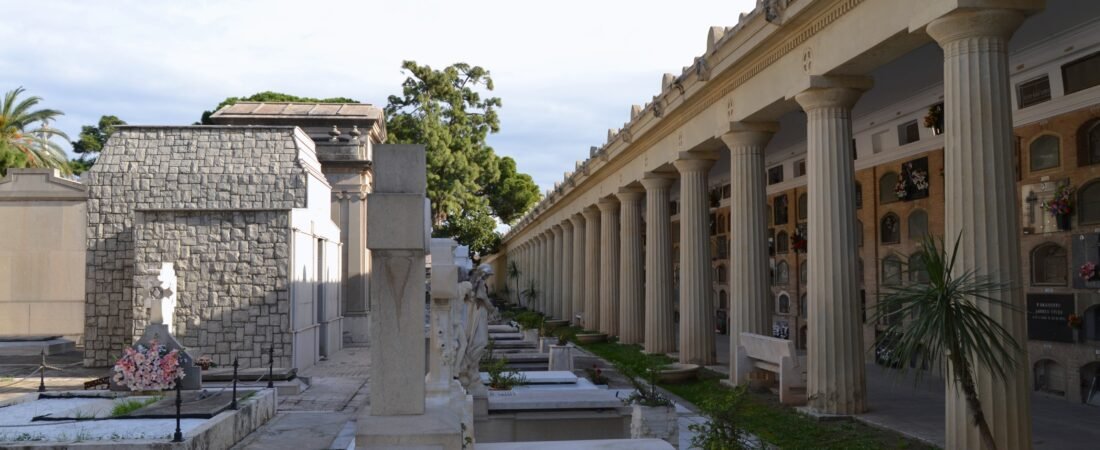
One hundred and seventy columns. Mausoleums that look like miniature chapels. And a cross whose name carries the memory of cholera.
At Valencia’s Cementerio General, the architecture catches your attention before you have read a single inscription. You come expecting graves and find yourself looking at doorways, pediments and stone figures, wondering who wanted to be remembered this way.
Stand here for a moment. Let your eyes travel from the grandest monument to the names beneath it. That is where this walk begins: with the distance between a life and the small piece of it that survives in stone.
The courtyard of 170 columns
The Patio de las Columnas is framed by 170 Doric columns. Within this formal setting, family mausoleums occupy the courtyard around the central cross. The effect is almost theatrical: a shared architectural frame, and within it, many different ideas of remembrance.
Look along the porticoes rather than rushing straight to the largest tomb. Repeated columns give the eye a rhythm; individual monuments interrupt it. A surname becomes a destination. A doorway invites a closer look, even when there is no door you can enter.
One detail to look for: lion-head gargoyles appear in the colonnade’s architectural decoration. Even here, above the serious business of remembering, someone found room for a face.
The cross at the centre
The Cruz del Cólera was designed by Antonio Ferré in 1892. Its presence changes how you read the courtyard. Around it are monuments that preserve family identities; its name turns your thoughts towards epidemic loss.
There is no need to invent a haunting for this place. Imagine a city in which an ordinary day could become the day a household began to mourn. Then look again at the cross. The stone is still; the history behind its name is not.
That is what makes this courtyard so affecting. Beauty draws you closer, and only then do you begin to consider what it was built to hold.
Walk through the cemetery with us
Join our cemetery walking tour below and explore at your own pace. Pause whenever a monument catches your attention: a quiet walk often reveals more than a hurried search for the most famous grave.
Prefer to watch on YouTube? Open our Valencia cemetery walking tour.
Mausoleums: the houses people built for memory
Some of Valencia’s prominent families commissioned architects to give their memorials a distinctive presence. José María Manuel Cortina’s work here includes mausoleums for families such as the Puchol Sarthou and the Oyanguren; Antonio Martorell and Vicente Rodríguez also contributed to the cemetery’s architecture.
Think of these commissions as a final architectural portrait. A home might announce how a family wished to live. A mausoleum suggests how it wished to be remembered. Faith, affection, status and grief could all occupy the same small building.
But a magnificent façade cannot tell you everything. Who chose the design? Who returned with flowers? Which name was spoken most often at home? Those questions remain beyond the inscription, and that absence gives the monuments much of their power.
Try choosing one modest memorial as well as one grand mausoleum. Give each the same attention. The difference in scale is visible; the depth of someone’s loss is not.
Why Valencia built a city for its dead
The General Cemetery opened in 1807. It belonged to a broader change in burial practice, as concerns about public health encouraged burials beyond crowded urban centres.
Over time, a place created to receive the dead became a record of the living city’s changing tastes and ambitions. Walking through it today, you can read architecture as a kind of handwriting: each generation leaving a different mark.
The name Museo del Silencio, used for the cemetery’s cultural interpretation project, feels particularly apt. Here the collection is inseparable from the people it remembers.
Blasco Ibáñez and the monument that waited decades
One of the cemetery’s most surprising stories belongs to the Valencian novelist Vicente Blasco Ibáñez. He died in Menton, France, in 1928; his remains returned to Valencia in 1933. That year, the city commissioned a funerary project involving architect Javier Goerlich and sculptor Mariano Benlliure.
Work began in 1935, but the Civil War interrupted it. Benlliure’s sculptural monument spent decades away from its intended setting before being installed in the cemetery entrance vestibule on 23 April 2021.
The unexpected detail: this is a cenotaph, not the container holding the writer’s remains. It was conceived to crown a crypt. The distinction matters: the sculpture tells a story of remembrance, interrupted plans and a very long wait.
If his name sounds familiar, follow another thread into our story of Valencia’s Patriarca crocodile and dragon legend, which Blasco Ibáñez also brought into literature.
How to visit with curiosity and respect
The cemetery is an active place of burial and mourning. Keep voices low, give families and ceremonies space, and follow any signs or staff guidance about access and photography. Its atmosphere is best experienced without turning someone else’s grief into a spectacle.
The municipal listing gives the address as Plaça de Sant Doménec de Guzmán, 27, Valencia. Check the official cemetery information before travelling, especially around public holidays and All Saints’ Day.
Begin with the columned courtyard and the cross, then let a few individual monuments slow you down. You do not need to collect every famous name. Sometimes the most memorable encounter is an unfamiliar one.
Sources and photograph
Historical details were checked against Valencia City Council’s heritage catalogue, its cemetery directory, its account of the Blasco Ibáñez cenotaph, and Fernando Pingarrón-Esain’s study of the courtyard and monumental cross. The atmospheric passages are our interpretation of the setting, rather than claims of supernatural events.
Featured photograph: Joanbanjo, Wikimedia Commons, licensed under CC BY-SA 3.0; resized for display.

Keep discovering the Valencia behind the façades
Back in the Old Town, there are more doorways worth stopping at and more details easy to walk past. Our Valencia Local Guide brings mapped stops and prepared audio stories together on your phone, so you can explore at your own pace without downloading an app.
Buy access for your city walk, or start by exploring the available options. The guide covers Valencia’s city sights; this cemetery walking video is a separate experience.
Planning your route? Read our Valencia Old Town self-guided walk or explore the story of the Holy Grail in Valencia Cathedral.