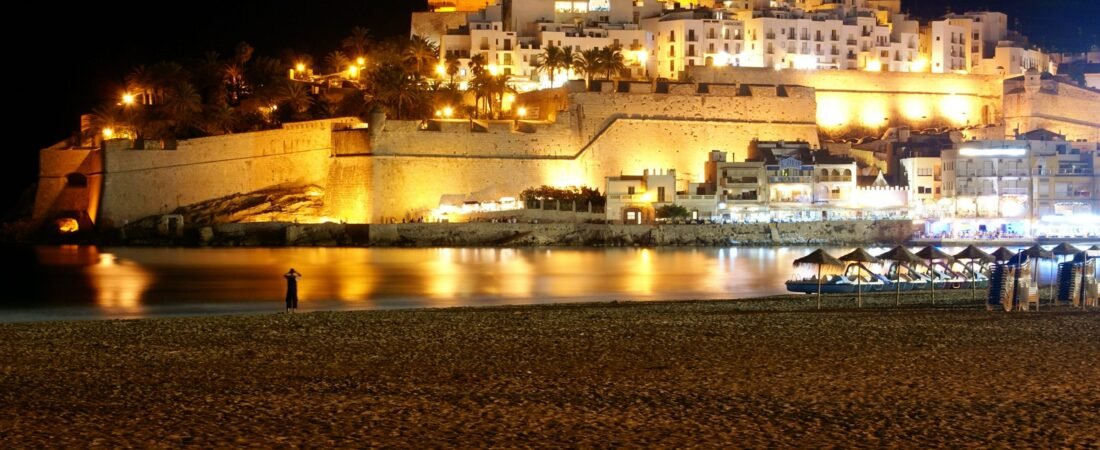
A castle at the edge of the sea. A divided Church. An old man who would not relinquish his claim. In Peñíscola, the most compelling story is already written into the rock.
From a distance, Peñíscola looks almost too beautiful to have been a refuge. White houses gather beneath a fortress, the sea opens around them, and the whole old town seems to lean away from the mainland towards the horizon.
It is easy to imagine coming here to escape the world. It is harder to imagine coming here while insisting that the world should still answer to you.
Yet that is the tension at the heart of the story of Pedro de Luna, remembered as Pope Luna. His final stronghold was this castle above the Mediterranean. To understand why it mattered, we must begin inland, in a room where agreement proved impossible.
The story we left unfinished in Morella
In our Morella and La Balma story, we encountered the meeting of 1414 between Benedict XIII, King Ferdinand I and the preacher Vincent Ferrer. The aim was to resolve the Western Schism. Morella’s municipal history describes fifty days of negotiations without a solution.
Fifty days of discussions, waiting and persuasion. And still the question remained: who had the right to lead the Church?
Peñíscola is the next chapter. The mountains give way to the coast, but the central conflict follows us. A belief held with absolute conviction does not become easier to abandon simply because powerful people ask you to surrender it.
Before the pope, there were the Templars
The castle had a history of its own before Luna made it a papal residence. The Knights Templar built the fortress between 1294 and 1307 over an earlier Muslim stronghold.
That sequence is worth keeping in mind as you climb. This was not a palace designed around one man’s retirement. It was an existing place of defence, later adapted to the needs of a papal court. Its severity belongs to a different purpose.
Look at the mass of stone, the restricted openings, the relationship between the fortress and the rock beneath it. The setting supplies the drama without needing a hidden treasure to explain it.
A detail to carry with you: “Templar castle” and “Pope Luna’s castle” describe successive chapters of the same building. The pope did not build the original fortress.
How could there be more than one pope?
The Western Schism divided Latin Christianity between competing papal claimants. Pedro de Luna became Benedict XIII in the Avignon line in 1394. After an attempt to settle the division at Pisa in 1409, there were three rival claimants rather than two.
This was not simply a quarrel inside a church. Obedience involved rulers, territories and political loyalties. A decision about whom to recognise could reshape alliances far beyond the walls of any cathedral.
Luna is generally classified as an antipope in the accepted papal succession. The term identifies his disputed claim; it should not be mistaken for a description of a supernatural villain. To his supporters, and to Luna himself, the issue looked very different.
Imagine how difficult it would be to negotiate a compromise if you believed the thing you were being asked to give up was not yours to bargain away. That is one way to approach his refusal without having to agree with it.
A court on a rock above the sea
Peñíscola became Luna’s residence during the final phase of his struggle. Here a military fortress also served as a place of papal government, worship and daily life.
Stand on a terrace and look outwards. Today the open sea can feel like freedom. For someone whose circle of recognition was shrinking, the same horizon might suggest distance, isolation or the possibility of help arriving from somewhere beyond sight.
We cannot recover his private thoughts from the view. But we can recognise the remarkable contrast between the small physical territory he occupied and the vast authority he continued to claim.
The castle is still substantial. The world beyond it is much larger. The story lives in that imbalance.
The ending that did not persuade him
The election of Martin V at the Council of Constance in 1417 marked the recognised resolution of the schism. Luna nevertheless maintained his claim. He died at Peñíscola in 1423.
A modern scholarly reassessment notes debate over the precise timing of his death, although 23 May 1423 is the date most commonly accepted. It is a small reminder that even a famous final chapter can contain unresolved details.
The powerful ending is not a last battle staged for our entertainment. It is the persistence of a conviction after the wider political settlement had moved on.
Was that courage, pride, conscience or an inability to yield? A castle visit does not have to settle the argument. It can leave you with a better question than the one you brought.
The legend of the staircase and the floating cloak
History gives us the isolated claimant. Folklore gives him a way across the water.
In one recorded legend, Luna descends towards the sea by a hidden staircase cut into the rock. At the water’s edge he spreads his papal cloak over the waves and uses it to travel towards Rome, determined to confront his rival.
The image is wonderfully defiant: the sea, which should make the journey impossible, becomes his road. Versions of the tale embellish the staircase and the miraculous crossing in different ways.
This is a legend, not a documented escape. Its value lies in what it reveals about his remembered character. The man who would not accept a political ending becomes, in the story, a man who will not even accept the ordinary limitations of water and stone.
You do not need to search for a secret passage to enjoy it. Look towards the sea from a public viewpoint and let the contrast do its work: a real horizon, an impossible voyage, and a reputation that outlived its owner.
The smaller objects that survived the great dispute
A fortress can dominate a story so completely that we forget the things people held in their hands. Peñíscola’s papal heritage also survives in objects associated with the court.
The protected collection in the parish of Santa María includes a rock-crystal papal cross or staff and a chalice from Luna’s private chapel. The heritage declaration also identifies a relic associated with Clement VIII, who succeeded him in the Peñíscola line before renouncing his claim in 1429.
These objects bring the story back to a human scale. A building tells you where power sheltered. A cup or a staff suggests the repeated gestures through which that power was expressed.
A useful distinction: the chalice associated with Papa Luna is not Valencia Cathedral’s Holy Chalice. They are separate objects with separate histories. If viewing the parish collection interests you, check local access arrangements rather than assuming it forms part of the castle ticket.
El Bufador: where the town seems to breathe
Leave the castle and follow the old town down towards El Bufador. Here the mystery belongs to the landscape.
A natural opening connects the rock beneath the town with the sea. Water and air moving through it can produce the sound that gives the place its name. Its force depends on sea conditions; a quiet visit and a stormy one need not sound remotely alike.
After the story of Luna’s impossible voyage, this is a fitting place to pause. The sea is no longer a blue backdrop for a photograph. It has a voice inside the rock.
Listen from the designated public area and respect barriers. There is no need to approach the opening to understand why a place like this encourages the imagination.
How to follow the story on your visit
Begin by looking at the old town from outside, so that you understand the shape of the headland before entering its streets. Then take your time climbing towards the castle. The changing glimpses of sea are part of the approach.
Inside, give the rooms and terraces time to register. Think about the two main lives of the building: Templar fortress and papal residence. Afterwards, wander back through the old town towards the seaward streets and El Bufador. Leave room for lunch, a promenade walk or simply a pause beside the water.
Peñíscola is in Castellón province, north of Valencia city. The old town has slopes, cobbles and steps. Check the castle’s official visitor information when planning an independent visit.
You do not have to choose between enjoying the seaside and following the history. The contrast is what makes the day memorable: a dispute that once divided Europe, followed by the very ordinary pleasure of lunch beside the Mediterranean.
Sources behind the story
The historical framework draws on Morella Town Council, Peñíscola’s architectural heritage catalogue, the official castle website and a scholarly reassessment of Benedict XIII. The staircase and cloak are presented as folklore, recorded in Leyendas para una historia paralela del Aragón medieval.
For the papal objects, see the official heritage declaration. For El Bufador, see Peñíscola Tourism. Historical events, religious claims and legends are distinguished throughout this story.
Come to Peñíscola with us
You have followed Luna from the negotiations in Morella to his last stronghold above the sea. Now you can stand where that final chapter unfolded.
Our private Peñíscola day trip from Valencia includes return transport, a professional driver, castle admission and a Peñíscola Pocket Guide for every guest covered by the booking. Use the mapped stops and prepared English audio to explore the old town and castle at your own pace.
The sightseeing is self-guided with the Pocket Guide; a human walking guide is not included. There is free time for lunch and exploring within the agreed day’s schedule. Check your date and group size on the tour page for the current price and full booking details.
The argument ended centuries ago. The place still has a way of making you listen.