A fortress above the clouds. A dance with death. A sanctuary swallowed by a cliff. Beyond Valencia’s sunlit coast, the mountains keep a different kind of story.
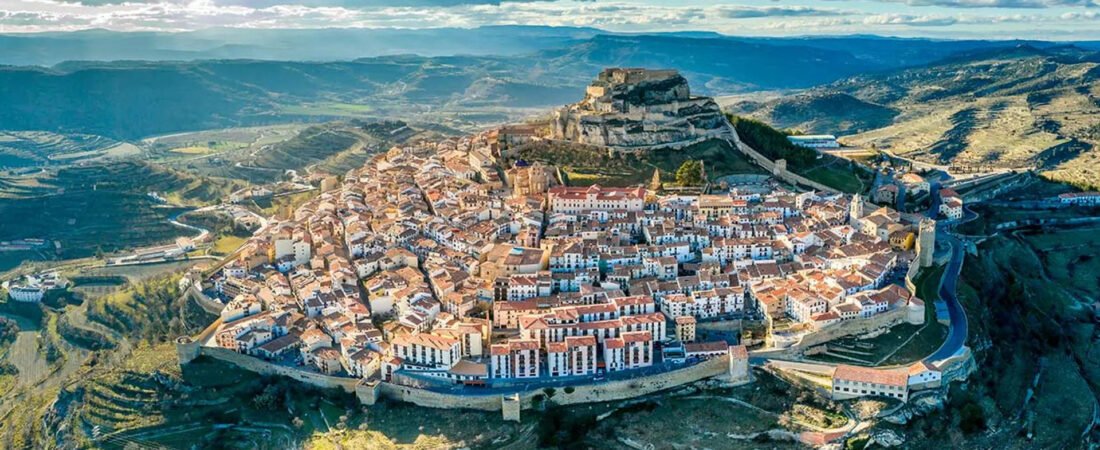
Picture the road climbing inland. The sea has disappeared behind you. The landscape folds into ridges, pale rock and valleys, and then Morella rises ahead: roofs gathered around a great stone crown, enclosed by walls that make the whole town look like something carefully guarded.
Your first instinct is to photograph it. Your second should be to wonder what those walls have witnessed.
Because the dark legends of Morella do not belong to a single haunted house. They run through its religious art, its stories of miracles, its wars and the lives of people who once had very good reasons to remain unnoticed. Beyond the town, at La Balma, they lead into the troubled history of exorcisms.
Some of what follows is documented history. Some is religious tradition or folklore. We will tell you which is which. The atmosphere needs no invented ghosts.
Follow the story: La Balma sanctuary · The exorcisms · Visit with us
1. The town beneath the fortress
Before following a legend, look up. Morella’s castle makes you do that again and again. From the streets below, the rock seems less like a backdrop than a presence: a reminder that someone once watched the approaches while everyone else lived beneath them.
The Christian conquest came in 1232, when Blasco de Alagón took Morella from Muslim rule. Its possession then became a matter of royal power under James I. This was a strategic prize, not a picturesque retreat.
Try changing the question you ask of a medieval wall. Instead of “How beautiful is it?”, ask “Who needed it?” Suddenly the same stone begins to tell another story. A gate becomes a decision about who may enter. A tower becomes a place from which danger might first be seen.
2. The fugitive hiding in an ordinary life
One of Morella’s most compelling secrets has no supernatural element at all. Guilhem Belibasta, remembered as the last Cathar elder, hid here after escaping the Inquisition in Occitania. He worked as a basket maker while maintaining connections with believers elsewhere. Lured back towards the Pyrenees, he was captured and burned in 1321.
Think of the quiet disguise of that occupation. Reeds, hands, a basket taking shape. Nothing about the finished object would tell a passer-by what its maker believed, whom he feared or what a careless conversation might cost him.
There is a particular unease in discovering that a town’s hidden history may have looked entirely ordinary while it was happening. Not a secret chamber. Not a coded inscription. Someone working, listening, and hoping to be left alone.
3. A pope, a king and a meeting that could not heal a divided Church
In 1414, Morella hosted Benedict XIII, known as Pope Luna, King Ferdinand I and the preacher Vincent Ferrer. Their negotiations sought to end the Western Schism, when competing claimants divided the Church. According to the municipal history, fifty days of talks failed to resolve the conflict.
Fifty days is a long time to wait for certainty. Imagine arriving in a town convinced that authority could settle a question, then discovering that the men claiming authority were the question.
A curious detail: Morella’s connection with Pope Luna belongs to the same wider history that draws visitors to Peñíscola. These mountain and coastal landscapes are linked by more than a scenic road.
4. The child in Morella’s darkest miracle legend
There is a far more disturbing story attached to Vincent Ferrer’s stay. In a local legend, a woman preparing a meal for the holy visitor kills and cooks her own child. The saint discovers what has happened and restores the child to life. Some versions retain a terrible detail: a missing finger.
A ceramic panel on Carrer de la Mare de Déu de Vallivana recalls the tradition. It is the kind of detail you might pass without stopping, until you learn what it represents.
This is a miracle legend, not an established account of a historical crime. Its variations belong to the world of religious storytelling, where an impossible catastrophe gives a saint an equally impossible act of restoration to perform.
You do not have to accept the miracle literally to feel the story’s force. A familiar street, a domestic doorway, an image on a wall: after hearing it, the everyday setting feels strangely changed.
5. The Dance of Death: the image that takes everyone’s hand
At the Franciscan convent of Sant Francesc, a fifteenth-century mural known as the Dansa de la Mort brings different ranks of society together around death. Nobility, clergy and ordinary people share the same destination.
The message could hardly be less interested in status. The clothes that identify a person’s place in life cannot purchase a different ending.
It is a powerful thought to leave on a wall in a religious house. A visitor may arrive admiring medieval craftsmanship and find themselves confronted by a question that has lost none of its urgency: what, exactly, are you doing with the time you have?
Before you visit: Morella’s official tourism page currently lists the convent as closed because of works. The mural is part of the town’s story, but viewing it should not be assumed to be available on your trip.
6. The promise made after the plague
Not every encounter with death in Morella ends in darkness. Some end in colour.
After the plague of 1672, the town attributed its deliverance to the Virgin of Vallivana. In 1673, a vow established celebrations in her honour every six years: the origin of the Sexenni. The gratitude is a matter of religious belief; the vow and the tradition it created belong to the documented history of the town.
During the celebrations, handmade paper decorations transform the streets. Knowing the origin changes how you look at them. Their delicacy becomes part of their meaning: patient work offered by one generation in fulfilment of a promise made by another.
A detail worth remembering: Vallivana and La Balma are different sanctuaries. Their names belong to different traditions, even though both help explain the spiritual landscape around Morella.
7. The Tiger of the Maestrazgo
The nineteenth century brought another kind of fear. Morella became closely associated with the Carlist commander Ramón Cabrera, the “Tiger of the Maestrazgo”. In 1838 he received the title Count of Morella; in 1840, the town fell to the forces of his rival, Baldomero Espartero.
Even the apparently simple question of where Cabrera lived in Morella remains uncertain in the municipal account: the castle and a house within the town appear in the evidence. It is a useful reminder that history does not always leave us the tidy answers a tour guide might wish for.
Look again at the fortress. The postcard has not changed. What has changed is your awareness of how often the people underneath it had to live through someone else’s struggle for power.
8. La Balma: the sanctuary inside the mountain
Beyond Morella, near Zorita del Maestrazgo, the story moves from defended streets to an exposed cliff. Here stands the Santuario de la Virgen de la Balma, also called the Santuario de la Mare de Déu de la Balma. You may encounter the name “Monasterio de la Balma”, but the site is more accurately described as a sanctuary.
It occupies a long natural recess in the rock above the Bergantes valley. The mountain does not merely surround the building; it determines its shape. Architecture follows the space the cliff allows.
There is something unsettling about a place that seems at once protected and precarious. The same rock that shelters it also presses close. You are looking at a human attempt to make a home for prayer inside something immensely older than the prayer itself.
Local tradition tells of the Virgin appearing to a shepherd and asking for a place of devotion. In one version, the shepherd’s disabled arm is healed. This is the sanctuary’s foundation legend, not a verified supernatural event.
A small discovery: the word balma refers to a natural rock shelter or shallow cave. The name describes the very feature that makes the place so extraordinary.
9. The exorcisms of La Balma
Then comes the part of La Balma’s history that visitors tend to hear in lowered voices. People once came here seeking release from afflictions understood as possession.
The association with exorcisms is documented in regional tourism publications. An official guide records a ritual manual written by a local priest in the seventeenth century and places the great surge in these practices in the late nineteenth and early twentieth centuries.
The most unsettling element is who sometimes performed them. Women known as les Caspolines conducted rituals, including practices outside ecclesiastical control. Another regional guide connects these women with Caspe. Their activity should not simply be confused with officially authorised Catholic exorcism.
For a moment, set aside the word “demon”. Think instead of a family carrying a fear they could not explain, travelling towards a place where they hoped someone would know what to do. The journey itself might have been an act of desperation.
We cannot diagnose the individuals involved from these accounts, and a historical description of possession does not establish a supernatural cause. What remains deeply human is the search for relief, and the vulnerability of those who sought it.
The regional account also warns that crowds, commercial interest and sensational reporting helped distort La Balma’s reputation. That matters. The history is already disturbing without turning every lurid later claim into fact.
What makes this place linger in the imagination is not a promise that you will encounter something paranormal. It is the knowledge that people once arrived here believing the answer to their suffering might be waiting inside the rock.
10. The devil at the crossing — and the escape above the cliff
La Balma’s traditions also include a theatrical confrontation between an angel and a devil at the covered cross on the approach to the sanctuary. In the regional guide’s description, the devil blocks the procession until the angel defeats him. This is ritual theatre, distinct from the historical exorcisms.
There is also an escape story associated with Tomàs Peñarrocha, the Carlist known as el Groc. The same guide links a juniper above the sanctuary with his flight from pursuers when cornered there. Treat it as a local historical tale rather than an invitation to seek out or attempt the route.
The two stories leave very different images: a symbolic struggle staged before a community, and a fugitive looking for a way out of a cliffside refuge. Both turn the landscape into something you read, rather than simply admire.
What to know before following these stories
Morella and La Balma are separate places in inland Castellón, within the Valencian Community. This is a journey beyond Valencia city. Allow for walking on slopes and steps, and check access arrangements for the day of your visit.
La Balma remains a place of devotion. Visit with the same consideration you would bring to any active sanctuary. Its past is something to understand, not a performance to expect.
If this is the side of the region that draws you in, continue with our Dark Secrets of Valencia: 8 True Stories & Local Legends. The city has its own hidden chapters.
Sources behind the stories
Our historical framework comes from Morella Town Council’s history, its account of Cabrera, and official tourism information on Sant Francesc and the Sexenni. The child’s miracle is presented as folklore, with a regional account of the legend.
For La Balma, see the official sanctuary description, the foundation tradition, and regional guides to Els Ports and walking routes, which discuss exorcisms, local traditions and the danger of sensationalised accounts.
Come beyond the walls with us
A photograph can show you Morella’s skyline. It cannot give you the feeling of standing beneath it, knowing the stories carried by the stone.
Join our Morella day trip from Valencia with Travel to Valencia, including a visit to La Balma sanctuary. Follow the journey from the medieval town to the remarkable cliffside place of pilgrimage, and discover a quieter, stranger side of the region.
See the tour page for booking details and contact us to confirm your date and the day’s arrangements.
Some places are beautiful from a distance. These ask you to come closer.