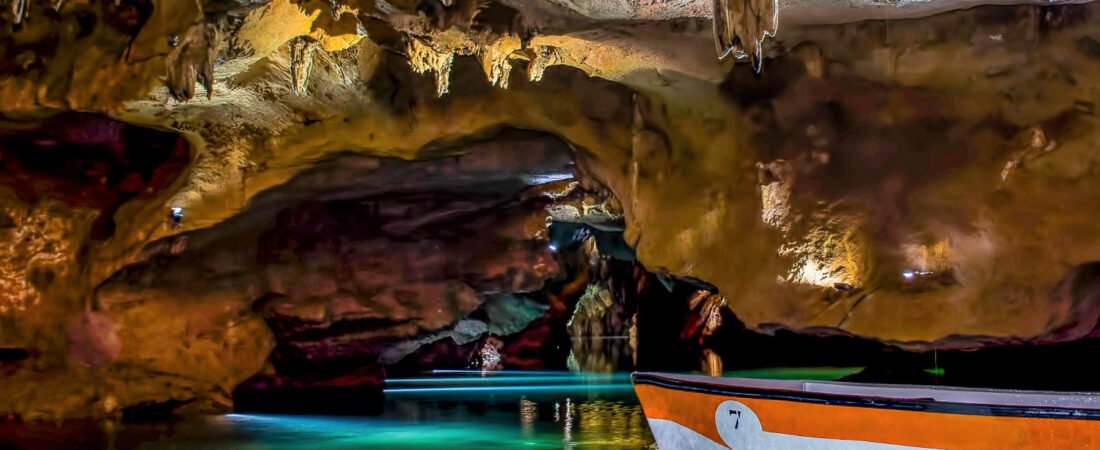
The boat slips into the mountain. Beyond the light, the passage disappears into darkness. People were living at this entrance around 17,000 years ago. What did they imagine was waiting inside?
At Coves de Sant Josep, in La Vall d’Uixó, north of Valencia, an underground river provides an unusual way to explore the landscape: from inside it.
The boat ride is the part most visitors come for. But the cave has a much longer story, stretching from prehistoric occupation to modern exploration. As recently as 2023, explorers discovered another chamber beyond the familiar visitor experience.
For a day trip from Valencia, you can explore the underground river and cave dining experience with Travel to Valencia.
People were here long before the boats
Archaeological evidence at the cave entrance places human occupation here around 17,000 years ago, during the Upper Palaeolithic. The site’s official history also records prehistoric paintings and engravings.
That changes the way you look at the entrance. Stand there for a moment and imagine it without the signs, the lights or the waiting boats. The rock would still rise above you. The water would still lead towards a space you could not see. What the earliest visitors believed about that darkness is not something the surviving evidence can tell us.
The water gives the story a sense of continuity. Generations separated by thousands of years encountered the same striking feature: a river emerging from the rock. For today’s visitor, the boat trip offers a brief encounter with a place whose human history reaches far beyond the buildings outside.
Beyond the passage that stopped the explorers
The cave’s official historical timeline records how difficult it once was to reach the spaces that visitors now associate with the attraction.
In 1926, a group of local residents passed the constriction known as Boca del Forn and reached Lake Diana. Further progress was blocked by the flooded passages of the Galería dels Sifons.
A first topographic plan followed in 1958. Then, on 13 November 1960, explorer Joaquín Saludes passed through the siphon gallery and demonstrated that the cave continued beyond it.
Developing the visitor route also involved engineering. Narrow sections were widened, including through blasting. The comfortable journey offered today rests on a history of exploration and substantial work to make parts of the cave accessible.
As the boat approaches another bend, try to picture the passage before it was illuminated. For the early explorers, a dark opening was a question without an easy answer. Today, the visitor route makes the journey comfortable, while the rock beyond the lights keeps its distance.
A new chamber, discovered in 2023
The exploration story continued long after the cave became a visitor attraction.
La Vall d’Uixó’s municipal tourism service records the discovery of Sala d’en Guillem in January 2023. It credits the Grup d’Expedicions Subterrànies Alt Palància and the Grup d’Espeleobusseig EOM, accompanied by the Espeleoclub la Vall d’Uixó.
The discovery offers a useful perspective on a visit. A published route can feel like a complete account of a place: an entrance, a sequence of named spaces and an exit. Here, the history of exploration extends beyond that experience.
Sala d’en Guillem is not listed among the stops in the standard visitor itinerary checked for this article. The discovery belongs to the wider story of the cave; it should not be taken as a promise that your boat will enter the new chamber.
Where does the water come from?
You may encounter descriptions presenting the river’s origin as entirely unknown. The geology offers a more precise picture.
Spain’s Geological and Mining Institute, IGME, describes a karst system developed in Triassic limestone. Its inventory identifies two sinkholes in neighbouring Alfondeguilla — Avenç de la Guilla and Avenç de la Riera — that feed the system, together with the underground river and its emergence at the Fuente de San José in La Vall d’Uixó.
There is a difference between understanding the main water system and having explored every passage. The discovery of another chamber in 2023 makes that distinction tangible. Knowing how water reaches the cave does not make the darkness around the next bend feel any smaller.
What the visit involves today
The official booking information describes a visit of approximately 45–50 minutes, with a route of up to 1,050 metres. It combines an 800-metre boat section and a 250-metre walk through a dry gallery, when that gallery is suitable for use.
The listed spaces include the Sala de los Murciélagos, Lake Diana and the Paseo de los Enamorados. These names give individual chambers and passages their own identity as you move through the cave.
Plan your arrival around a confirmed entrance time. Tickets are limited, and the operator recommends buying ahead rather than relying on availability at the ticket office. Allow time for the walk from the parking area, too.
Current access arrangements and the available route should always be checked when booking.
Continue the experience with lunch inside the rock
There is a natural way to carry the theme into the rest of the day: follow the underground river visit with a meal in a restaurant built into the rock.
Travel to Valencia’s Underground River & Cave Dining Experience combines transport from Valencia, the cave entrance and boat experience, and a reserved Mediterranean lunch. The restaurant is a separate stop after the caves.
For current inclusions, availability and booking conditions:
When the boat returns towards daylight, the mountain has not given up all of its story. You have followed a visitor route through a place known to prehistoric people, opened gradually by explorers and still capable of revealing something new. The next time you see a river flowing out of the rock, you may find yourself looking a little longer at the darkness behind it.