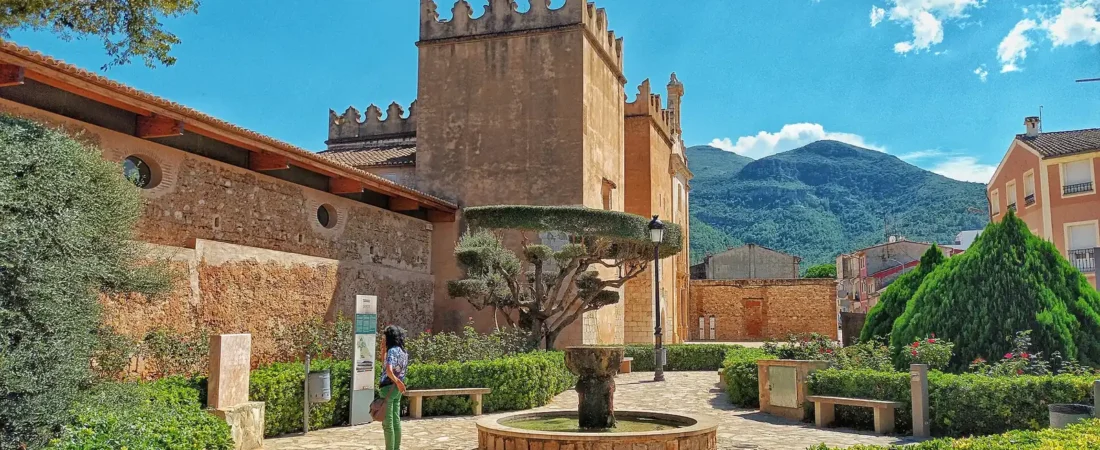
Imagine arriving at an old monastery with a simple intention: take a few photographs, admire the church and continue your journey. Then someone tells you that part of the building once left the valley.
Not a painting. Not a chest of silver. Its arches.
At the Monasterio de Santa Maria de la Valldigna, the past has an unsettling habit of turning solid stone into a story about absence. There is a king’s legend, a community that disappeared, and architecture that had to find its way home.
This is Simat de la Valldigna, in the Valencian region of La Safor. Give the monastery more than a passing glance. Some of its most interesting stories concern the spaces between the things you can see.
A valley worthy of a monastery
Local tradition tells of King Jaume II being so impressed by the valley that he called it worthy of a monastery. His companion agreed, and the exchange became the story behind the name Valldigna — the worthy valley.
This conversation belongs to tradition. It is not a transcript from the roadside. The historical foundation is firmer ground: the Cistercian monastery was founded by Jaume II in 1298.
There is something appealing about a place name that asks you to look around. Before it is a date or a line in an itinerary, the legend is an invitation: stop here, pay attention, decide what you think this landscape is worthy of.
You do not have to accept the conversation as literal history to understand why people kept telling it.
Read the monastery as a place where people lived
The regional tourism authority describes a complex organised around its cloister, with spaces including the church, chapter house, abbot’s palace and former oil mill. Its architecture reflects successive periods of building and rebuilding, including a major transformation after the earthquake of 1644.
Those room names can sound like labels to collect. Try giving each one a human question instead. Where did people gather? Where did they work? What did a doorway separate? Who passed through it every day without imagining that a visitor would one day photograph it?
The Spanish state archives describe a community equipped with a refectory, kitchen, stores, cellars and monks’ cells. Alongside worship there was the practical business of feeding people and maintaining a place to live.
That is often the detail that makes an old monastery feel real. Imagine the meal after the prayer, the work that needed finishing, the familiar route from one room to another. These are prompts for the imagination, rather than a reconstruction of a particular monk’s day.
When the daily rhythm ended
The monastery was suppressed in 1835. The monks left, and the property passed into private hands. Agricultural use, demolition and the sale of building materials followed.
A ruined building can seem as though it simply faded with age. Here, it is worth pausing over the decisions behind the damage. Stone that had belonged to a religious community became material that could be sold and used elsewhere.
Think about what that does to a place. A wall loses its completeness one piece at a time. A doorway stops leading anywhere. Eventually, someone looking at the remains has to work backwards to understand how they once fitted together.
The silence a visitor imagines today is therefore only one chapter. Before it came repeated activity; after it came the difficult work of recovery.
The arches that travelled away
Among the losses were Gothic arches from the upper cloister of the abbot’s palace. They became decoration at Canto del Pico in Torrelodones, near Madrid, before eventually returning to the monastery.
It is an extraordinary journey to picture. An arch is designed to belong to a place: it frames a view, links supports and helps define a space. Move it elsewhere and it acquires a new setting, while leaving a very particular absence behind.
When you visit, let this be your small challenge: look at the surviving architecture and consider it as something that people chose to preserve, relocate or recover. The stones did not make those choices. People did.
This is the monastery’s most compelling ‘secret’ for us. No hidden chamber is needed. The surprising story lies in the history of what stands in plain sight.
Recovery is part of the story
After local efforts to secure its future, the Generalitat Valenciana acquired the monastery in 1991 and began its recovery.
It is easy to tell the history of a monument as a rise followed by a fall. Valldigna asks for another chapter: what happens when a community decides that the remains still matter?
Restoration does not erase the losses. It allows a visitor to encounter them with enough context to understand something of the place that existed before. A recovered space can hold both gratitude for what survives and awareness of what has gone.
Three ways to look more closely
Start with the whole space. Before examining a detail, look at how the buildings and open areas relate to each other. Let your eyes follow a possible route through the complex.
Then choose one small thing. An opening, a carved detail or a change in the building fabric can hold your attention longer than another wide photograph. Use the interpretation panels to test your first impressions.
Finally, look back. After learning about the monastery’s abandonment and recovery, return your gaze to the view that first caught your eye. The scene may be unchanged, but you now have different questions to ask of it.
With children, make it a gentle observation game: find a doorway, an arch and a detail that suggests what a room was used for. Keep to visitor areas and enjoy discovering the answers together.
Visiting Santa Maria de la Valldigna
The monastery is in Simat de la Valldigna. Consult the official tourism listing for visitor contacts and check current opening and guided-visit arrangements before travelling.
Allow time to read the site’s interpretation rather than treating the complex as a quick photo stop. Comfortable shoes and water are sensible companions for a day exploring heritage sites. Access to particular spaces can depend on the arrangements on the day.
Why we pair Valldigna with Xàtiva
Our Travel to Valencia excursion combines Xàtiva and the Monasterio de Santa Maria de la Valldigna. Together, they offer two different ways of thinking about memory.
In Xàtiva, an upside-down royal portrait preserves an accusation against a king. At Valldigna, recovered architecture tells a story of loss and care. One place makes a deliberate gesture of defiance; the other invites you to consider what it takes to bring a damaged monument back into public life.
Read the other half of the journey in Xàtiva’s Upside-Down King: Fire, Revenge and a Portrait’s Secrets. The museum visit to see Philip V’s portrait is included in our combined tour.
Sources behind the story
The foundation tradition, dispersal of architectural elements and recovery history are documented by Simat de la Valldigna municipality. Architecture and visitor context: Comunitat Valenciana tourism. The monastery’s facilities and suppression are described in the Spanish state archives catalogue. The opening scene and reflective passages are our storytelling, not eyewitness testimony. Photograph from Travel to Valencia’s media library.
Discover Xàtiva and Valldigna with us
Make these stories part of a day out from Valencia. Our Xàtiva + Valldigna tour brings together the city, the included portrait museum visit and the monastery.
Send us your preferred date, group size and pickup location. We will confirm availability, the day’s itinerary and the price for your group.
A valley may keep its name for centuries. The work of keeping its stories belongs to each generation.