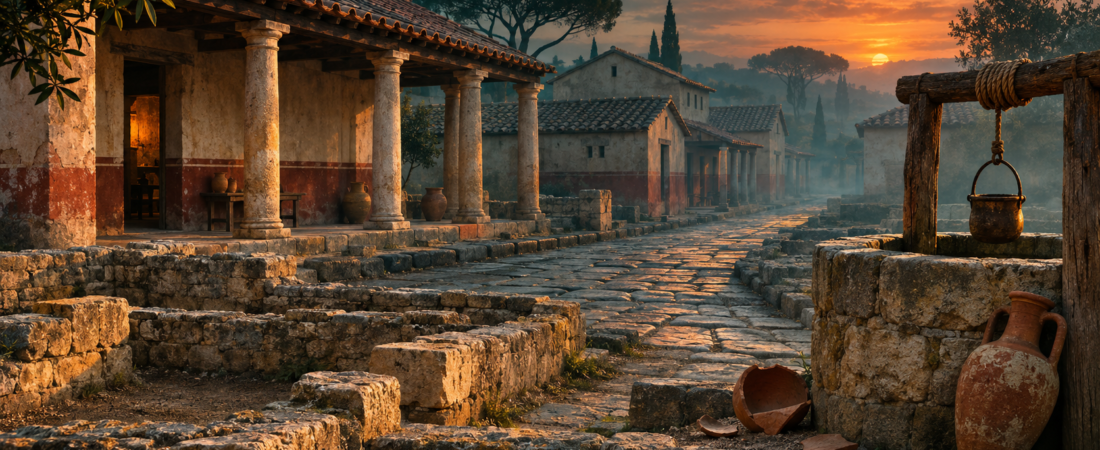
Cover image: AI-generated artistic interpretation of Roman Valentia; not a photograph or an exact archaeological reconstruction.
People walk through Valencia’s old town looking up at its towers.
But one of its darkest stories lies beneath their feet.
Below the streets around the cathedral are the remains of another city: Roman Valentia. A place of bathhouses, sacred spaces and ordinary daily routines. A city whose beginnings involved ritual offerings — and whose early history ended in violence.
The evidence survives in broken pottery, ancient foundations and the remains of people who never escaped.
To discover this Valencia, you have to look below the surface.
Before Valencia, There Was Valentia
The Romans founded Valentia in 138 BC, long before the cathedral, the medieval gates or the silk merchants who would later make the city wealthy.
Its foundation is associated with Decimus Junius Brutus and the settlement of discharged soldiers, who received land beside the new town.
Imagine arriving here with the task of building a new life: streets to lay out, homes to construct, fields to cultivate and gods to honour.
At L’Almoina, beside the cathedral, archaeology brings that first city into view. Its remains reveal a settlement with public baths, a granary and a sanctuary associated with Asclepius, the god of healing.
From its earliest years, Valentia was a place where practical needs and religious beliefs existed side by side.
The Offerings Beneath the City
One of the most intriguing discoveries at L’Almoina is a well associated with the city’s foundation rites.
Inside, archaeologists found animal remains and fragments of vessels linked to a ceremonial feast.
These objects offer a glimpse of an occasion that mattered deeply to the people establishing the settlement. Founding a city involved more than choosing a convenient location and drawing its boundaries. Ritual helped mark the beginning of a new community.
The remains do not preserve the words spoken that day. They cannot tell us what every participant believed or hoped for.
But they leave a compelling thought: beneath modern Valencia are traces of a meal shared when the city was new.
The Year Valentia Was Destroyed
In 75 BC, Valentia became caught in the conflict between Pompey and Sertorius.
Pompey’s forces destroyed the city.
At L’Almoina, the archaeological evidence makes this episode disturbingly tangible. The site’s official interpretation describes the discovery of 17 executed soldiers, accompanied by weapons.
This is where the story moves beyond dates and generals.
The destruction involved real people, on streets that now lie beneath a busy European city. Visitors above ground stop for coffee, photograph the cathedral and continue through the old town, often unaware of what was found below.
There is no need to invent a curse or a ghost story here. The surviving evidence is unsettling enough.
A City That Began Again
Valentia eventually recovered.
During the Roman imperial period, it developed public buildings and infrastructure, including a forum, a circus for racing and a river port near the site of today’s Serranos Towers.
The river connected the city to a wider world. People, goods and beliefs travelled through that world — and Roman Valencia was part of it.
Its history was not a single uninterrupted rise. It was a story of foundation, destruction and rebuilding.
That makes the layers beneath the old town especially meaningful. Each belongs to a different version of Valencia.
An Egyptian Goddess in Roman Valencia
One surviving inscription reveals another unexpected part of the city’s Roman past: a community devoted to Isis, the Egyptian goddess.
The Roman stone was discovered in the Turia riverbed in 1759. Its inscription records a group of her worshippers.
It is evidence of religious life reaching beyond the gods many visitors immediately associate with Rome. However, the inscription alone does not establish where a local temple to Isis stood.
For that separate story, explore the Egyptian goddess hidden beside Valencia’s Turia.
Where to Discover Roman Valencia Today
L’Almoina Archaeological Centre is the natural starting point.
Beside the cathedral, it preserves remains from several periods of the city’s history, including Roman Valentia. Give yourself time to distinguish the layers: not every wall or structure belongs to the same century.
Look for the ordinary details as well as the dramatic ones.
Baths tell us about daily routines. Storage buildings speak of food and supply. Streets show how people moved through their city.
Together, they make ancient Valencia feel less distant.
When you return to the streets above, the old town may look different. The buildings you can see are only part of its story.
Keep Exploring — With a Local Guide in Your Pocket
Continue your walk with Valencia Local Guide, our self-guided experience with mapped stops, audio stories and questions along the way.
L’Almoina is included among the full guide’s stops, connecting this corner of the city with the wider story of Valencia.