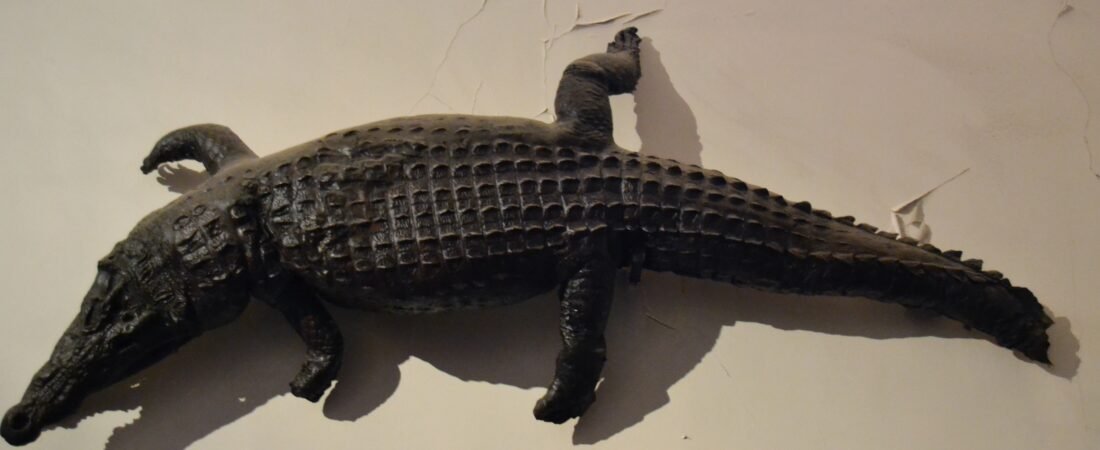
You expect saints in a Valencian church. Perhaps a candle burning beneath a painting, perhaps a face looking down from the ceiling. You do not expect a crocodile.
Yet there it is: a dark, elongated body fixed to the wall, its jaws still open. Outside, Valencia carries on with coffee, conversation and the ordinary business of the afternoon. Inside the entrance to the Patriarca church, something from a much older story waits.
This is the creature known as the Dragon of the Patriarch, or Dragó del Patriarca. The animal is real. The monster that supposedly terrorised Valencia belongs to legend. And the distance between those two things is where this story becomes irresistible.
When the river belonged to a monster
The following is a retelling of the legend made famous by Vicente Blasco Ibáñez in “El dragón del Patriarca”, from his collection Cuentos valencianos. It is folklore and literature, not a record of historical attacks.
In that story, the danger begins beyond the city gates.
Somewhere among the reeds beside the river, a creature has made its home. People who venture too close disappear. Men set out to kill it with weapons and confidence; the survivors return with rather less of both. Soon, the smallest movement in the vegetation is enough to empty a path.
A city can defend itself against an army. It can shut its gates, count its enemies and watch for their fires after sunset. But how do you defend yourself against something that seems to be waiting wherever you need to go?
The fields still need tending. People still need food. Each journey outside becomes a small wager with death.
Even a religious procession fails to settle the matter. In Blasco Ibáñez’s mischievous telling, the impressive ceremony loses its effect as soon as the creature opens its mouth. Retreat suddenly seems the wisest course.
Then the offer comes from the last person anyone would choose as a saviour: a condemned prisoner.
He will kill the dragon, he says, if the city spares his life.
The man who wore the sunlight
The prisoner does not ask for Valencia’s finest armour. He asks for time, a place to work, and glass.
Behind a closed door, preparations continue. Smoke rises from the chimney. People gather outside and wonder what sort of man might defeat a beast that has already defeated everyone else.
When he finally emerges, the crowd is disappointed. A rough cloak. A hood. A spear. Nothing about him looks like salvation.
He walks towards the creature anyway.
Then, at the moment when the jaws open, he drops his cloak.
Underneath is armour made of mirrors. Sunlight strikes it and scatters. The dragon sees its own terrible shape repeated across the shining surfaces: a confusion of mouths, scales and movement. For once, the creature that has made an entire city afraid is itself bewildered.
The man advances. The dragon retreats. The spear finds its opening.
That is how the legend gives Valencia back its freedom: with a prisoner, a daring bargain and a monster defeated by the sight of itself.
Blasco Ibáñez ends with a wonderfully cheeky invitation. Doubt the story? Go to the Patriarca and look at the animal. There is your evidence. The joke still works, because the crocodile is indeed there—even if the story attached to it cannot be taken literally.
The real crocodile has a name—and a date
Step out of the legend and a smaller, more precise mystery remains. Who brought this animal to Valencia, and why did it end up at a church door?
A 2015 study by Josep Francesc Bisbal-Chinesta and Jordi Alexis Garcia Marsà examines the specimen and its documentary history. It identifies an American crocodile, Crocodylus acutus, approximately 2.8 metres long.
The strongest detail comes from the diary of the cleric Pere Joan Porcar. His entry for 7 June 1606 records that Patriarch Juan de Ribera had the crocodile placed at the entrance. It also gives the animal a name: Lepanto.
You will often read that it was a gift from the Viceroy of Peru. The researchers are more cautious: Porcar mentions a servant who sent it, while the viceroy version appears in a much later account. The exact chain of ownership should therefore remain a question, rather than being polished into certainty.
There is something unexpectedly moving about that name in the diary. The legendary beast is anonymous and enormous. The real animal was Lepanto. Someone knew it well enough to call it something.
Why put a crocodile in a church?
Blasco Ibáñez also mentions an explanation far less dramatic than a battle at the river: the animal was understood as a symbol encouraging silence in a sacred place. His opening remembers children recoiling from it and taking refuge beside their mothers.
It is easy to see how such a sight could outlive any spoken instruction. A request to lower your voice is soon forgotten. An open mouth on the wall is rather harder to ignore.
The setting deserves attention too. The Real Colegio Seminario de Corpus Christi, generally called El Patriarca, was founded by Juan de Ribera in 1583. The institution’s own history highlights its role in training priests, its Renaissance cloister and the church’s frescoes by Matarana. The crocodile is one unusual detail within a much larger religious and artistic world.
A detail to remember: the dragon-slayer’s name disappears in the literary tale, but the crocodile’s name survives in a historical document. Lepanto has managed to keep the better paper trail.
Where to find the Patriarca crocodile in Valencia
Look for El Patriarca on Calle de la Nau / Calle de la Nave, opposite the historic university building. The crocodile is associated with the church entrance area, rather than Valencia Cathedral—a useful distinction when planning your walk.
Check El Patriarca’s official website before visiting for the available tours and access arrangements. The city’s visitor information states that sightseeing visits to the church use designated visit slots; worship access is reserved for those attending services. Avoid assuming that an open door means unrestricted sightseeing.
Once you have met the dragon, continue your afternoon with the Holy Grail of Valencia, or follow our Old Town walk through the stories behind the stones. For more small discoveries along the way, explore the tiny secrets most visitors walk past.
Sources and photograph
Legend: Vicente Blasco Ibáñez, El dragón del Patriarca (public-domain original). Historical research: Bisbal-Chinesta and Garcia Marsà, De regal arquebisbal a dragó de llegenda (2015). Building history: El Patriarca. Visitor arrangements: València City Council.
Featured photograph: Drac del Patriarca, València, Joanbanjo, 2014, via Wikimedia Commons, CC BY-SA 3.0. Resized for display.

Keep following Valencia’s stories
The pleasure of exploring Valencia is that an ordinary doorway can change the direction of your afternoon. You came looking for a church. You leave thinking about a prisoner dressed in sunlight.
For the rest of your Old Town adventure, take Valencia Local Guide with you: our pocket companion with mapped stops and audio stories, ready on your phone without downloading an app. Follow the route at your own pace, pause when a place catches your attention, and let the next story lead you onwards.
The digital guide is a separate product; admission or guided visits at El Patriarca are not included.