A doorway built for a smaller resident. A bird above the market. A musician hidden in stone. Some of Valencia’s best discoveries begin when you stop looking for the next famous building.
You can walk through the old town with a list and find everything on it. The cathedral, the towers, the market: photograph, tick, continue.
Or you can give the city a different task. Ask it to surprise you.
Lower your eyes towards a tiny door. Raise them towards a rooftop. Look at a familiar fountain long enough to wonder what its figures represent. Nothing has moved, yet the city begins to change. You are no longer passing through the scenery. You are reading it.
These six small discoveries make a gentle walk through El Carmen and the historic centre. The suggested order is Casa de los Gatos → Portal de la Valldigna → Plaza de la Virgen → Mercado Central → La Lonja → La Estrecha. Adapt it to your day; there is no prize for finishing first.
1. Casa de los Gatos: someone else’s front door
At Calle Museo, 9, a miniature house appears in the wall. Casa de los Gatos decorates a real opening for cats, complete with the kind of little details you expect on a much larger home.
It rewards a change of perspective. Crouch slightly and the street becomes enormous around it. Suddenly you are the oversized visitor at someone else’s address.
Your discovery: find three details on the miniature façade before taking your photograph. Look without touching, leave the opening clear and let any real residents come and go undisturbed.
2. Portal de la Valldigna: the boundary you can walk through
Continue towards Portal de la Valldigna. It is easy to treat an arch as a convenient way to reach the next street. This one deserves a pause.
The opening was made in 1400 through the earlier Islamic city wall to connect the city with the morería, the district established outside that wall after the Christian conquest. The portal therefore brings different periods of Valencia’s history together in a single small passage.
An old wall does not have to stand complete to shape the city. Sometimes the most revealing clue is the place where someone decided to open it.
Your discovery: stand to one side, away from passing pedestrians, and look through the arch. Then walk through and look back. Which view makes you most aware that this was once a boundary?
3. Plaza de la Virgen: a river disguised as a figure
In Plaza de la Virgen, the fountain is often part of the background. Someone poses, someone waits, the photograph is taken, and the group moves on.
Look again. The reclining central figure represents the River Turia. The eight female figures around it personify irrigation channels, the acequias. The monument is telling a story about water and the land it nourishes.
Once you know that, the square contains an invisible landscape: channels running away from a river, fields beyond the city, water travelling to places you cannot see from where you stand.
Your discovery: count the surrounding figures together. Before explaining them, ask your companions what they think the fountain might represent. A wrong guess can be a good beginning to a conversation.
4. The market’s rooftop parrot
At Mercado Central, appetite usually keeps your attention closer to the ground. This time, look up first.
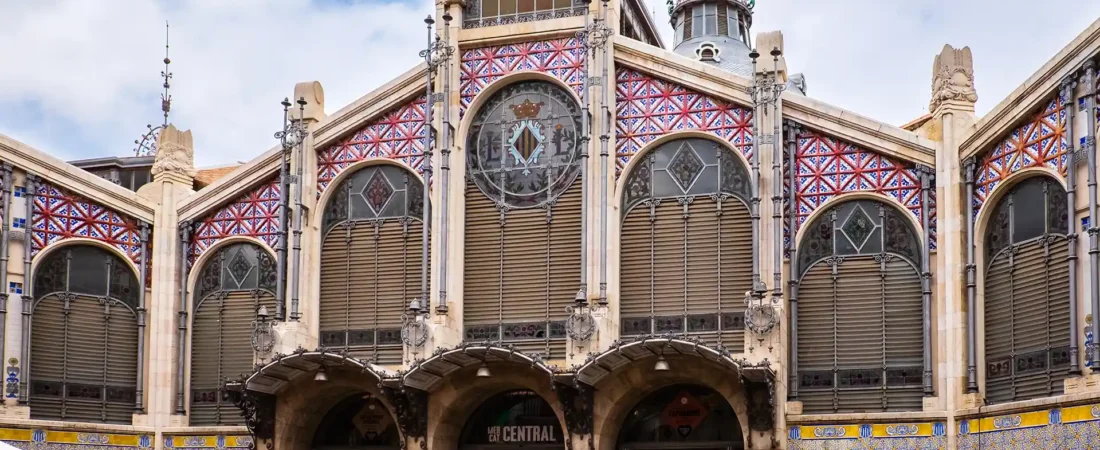
The market’s weather vanes include a parrot, the famous cotorra, and a fish. The city’s cultural route suggests the parrot may refer to the market as a place of chatter and gossip. That is an interpretation, rather than a meaning we can prove with certainty.
It is nevertheless an appealing thought. Below, people ask prices, exchange news and decide what to cook. Above, a bird associated with talk watches over the conversation.
Your discovery: try to spot both the parrot and the fish from the public space around the building. A phone’s zoom may help, but stop somewhere out of the flow of pedestrians before using it.
5. La Lonja’s unexpected musician
Across the market area, La Lonja can seem almost too grand for jokes. Its reputation belongs to Gothic architecture, commerce and an extraordinary trading hall. But the details have their own personalities.
The municipal cultural route identifies a flute-playing frog at the doorway into the Consulat del Mar, along with a lizard among foliage beneath the coat of arms. A building associated with serious business makes room for a very unlikely musician.
Do not rush past the smaller carvings after admiring the overall façade. Large monuments are made of decisions at every scale, including decisions that only become visible when someone chooses to look closely.
Your discovery: search for the frog during your visit, where access permits. Then choose a second creature or carved detail that interests you. Which would you give a story to? Keep your invented story separate from the building’s real history.
6. La Estrecha: a façade you could almost miss
Near Plaza Redonda, at Plaza Lope de Vega, 6, La Estrecha offers a different surprise: its façade measures about 107 centimetres across.
It is often promoted with claims about being the narrowest house in Spain or Europe. The visible width is the interesting part; its interior has been incorporated into the adjoining premises, so the façade does not describe a separate, intact miniature home.
Your discovery: compare it with the neighbouring façades. Photograph it straight on, then include its neighbours. Notice how the second photograph tells the story of its proportions more clearly.
A walk made of questions
You have found a cat-sized entrance, an old boundary, a river in disguise, a rooftop bird, a stone musician and an improbably narrow façade. None required you to race across the city.
That is the pleasure of this kind of exploring. The discoveries fit between the famous places, and they make the journey between those places worth remembering.
With children, let someone different lead the search at each stop. With friends, each choose a favourite detail and explain why. On your own, take one photograph that you would not have taken before reading the story.
For a longer route through the main sights, continue with our self-guided walk through Valencia’s old town. If you want the darker chapters, our Dark Secrets of Valencia follows a different trail.
Before you set off
Most of these discoveries can be enjoyed from public streets and squares. The Consulat del Mar detail may require entering the monument, depending on the visitor route; check admission and access arrangements. Allow time for stops rather than treating this as a timed challenge.
Remember that the old town is also a neighbourhood. Keep doorways clear, respect residents and animals, and avoid climbing or touching carvings. The most useful equipment is comfortable footwear, water and a little patience.
Sources behind the discoveries
Addresses and details for Casa de los Gatos and La Estrecha were checked against Visit València. For the portal and fountain, see Cultural València’s descriptions of Portal de la Valldigna and the monuments in Plaza de la Virgen. The animal details appear in the municipal cultural route around the market and Visit València’s Central Market curiosities.
Keep discovering with a local guide in your pocket
Hidden Valencia and Valencia Local Guide are both part of Travel to Valencia. We built our pocket guide for the moment when a place catches your attention and you want to understand it better.
Open it on your phone for mapped stops and prepared audio stories. Its optional family game includes seven discoveries, with clues, hints and the freedom to pause or skip a challenge. Children play with an adult. The six-stop walk above is an editorial suggestion, not the complete route or answer sheet for that game.
Try the free Serranos audio sample first. If you enjoy exploring this way, choose the guide plan that suits your visit. No app download is needed; see the product page for current prices, access periods and features.
The next thing you remember about Valencia might be the smallest thing you see.