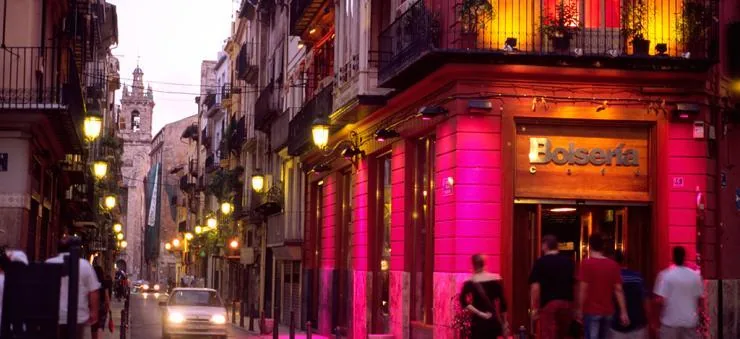
Wait until the light begins to leave the rooftops.
Valencia changes slowly. A doorway becomes a dark rectangle. The last glow catches a church tower. Somewhere beyond the next corner, glasses clink and someone laughs. It is still the warm, sociable city you came to visit.
But look a little closer.
There is a reptile hanging in a church. A medieval cemetery tucked inside the city. A beautiful gateway that once kept prisoners behind its walls. And, beneath the streets, rooms whose original purpose has almost slipped out of memory.
These are eight of Valencia’s dark secrets: real places with stories that linger. Some are documented history; others have gathered the glow of legend. Follow them, and familiar streets begin to feel different.
Choose a secret
- The dragon that never left the church
- A doorway between the living city and its medieval dead
- The square that remembers Margarida
- The beautiful gateway that once kept people in
- The wounds Valencia left on its walls
- Beneath City Hall, a different kind of school day
- The underground room that refuses to be only one thing
- The cup at the end of the question
1. The dragon that never left the church
Imagine coming to Valencia for sunshine and finding yourself face to face with a dead dragon.
At the Church of the Patriarch, the surprise has teeth. A preserved crocodilian hangs inside a place where you might reasonably expect saints, paintings and solemn silence. It is such an improbable sight that a question almost asks itself: how did you get here?
Valencia has a story for that.
According to local legend, a terrifying creature lurked by the Turia, making the riverbank a place to fear. The tale became part of the city’s imagination and found its way into Vicente Blasco Ibáñez’s The Dragon of the Patriarch. Suddenly, that strange animal in the church was more than an exotic curiosity. It was the monster from the story, still there to be pointed out.
The historical explanation is quieter: Visit València notes that some historians consider the animal a gift from the Viceroy of Peru to Patriarch Juan de Ribera. A diplomatic present became the perfect seed for a dragon legend.
A curious detail: the monster belongs to folklore, but the specimen does not. You can go looking for the object that helped keep the story alive.
Find it: the Church of the Patriarch, in the Corpus Christi complex. Check visitor access before entering.
2. A doorway between the living city and its medieval dead
Some of Valencia’s most intriguing discoveries begin with a very ordinary decision: walking through a doorway.
At San Juan del Hospital, on Carrer del Trinquet de Cavallers, that decision leads towards a medieval cemetery. The city outside carries on with its errands. Within the historic complex, your attention turns to stone, burial spaces and the long passage of time.
The church identifies this as Valencia’s only surviving medieval cemetery. Pause over that thought. All the generations that have rebuilt the city, widened its streets and changed its buildings — and this place remains.
Then the story reaches further back. The complex also preserves part of a Roman circus. Before the medieval burials, there was another Valencia here, with a very different use for the ground.
A curious detail: “Roman circus” means an ancient racing venue, not a tent full of performers. Remains of its central dividing structure, the spina, form part of the official visit.
If you prefer your history after sunset, the church also offers scheduled evening cemetery visits. Check its calendar and reserve where required.
Come for the hidden courtyard feeling. Stay for the unsettling pleasure of realising how many different cities can occupy the same patch of earth.
3. The square that remembers Margarida
Try a small experiment when you reach Plaça del Mercat: stop looking up.
The great buildings make that difficult. La Lonja draws your eye; the Central Market offers every reason to think about breakfast. But the square itself holds a story that deserves a moment of your attention.
On 28 July 1460, Margarida Borràs was publicly hanged here. Valencia City Council remembers her as a victim of persecution for her gender identity. The place where visitors now pause between landmarks was once the setting for her death.
There is no need to imagine her last words, or invent what the crowd said. The fact of what happened is powerful enough. A woman lived in this city, was persecuted, and became the subject of a punishment carried out in public.
Centuries later, the city chose to put her name back into the square. The council records the installation of a memorial plaque in 2017.
A detail worth remembering: the memorial came more than five centuries after her execution. A name that might have disappeared became part of the city’s public memory.
When you return to the bustle around the market, the square may look exactly as it did a few minutes earlier. You will know a little more about it.
4. The beautiful gateway that once kept people in
From outside, the Serranos Towers make a magnificent promise: there is a city worth entering here.
For the prisoners once held within them, the question was how to get out.
From the late sixteenth century, the towers served as a prison for nobles and knights. Picture the contrast rather than a particular prisoner: ceremonial grandeur on the outside, confinement within. A good family name did not necessarily mean an open door.
The strangest twist came later. When much of Valencia’s medieval wall was demolished in the nineteenth century, the towers’ use as a prison helped save them. The very purpose that made the building a place of confinement helped preserve the landmark we admire today.
And the towers had another life still to come. During the Spanish Civil War, they sheltered works evacuated from the Prado Museum.
A curious detail: one building has served as a ceremonial gateway, a prison and a refuge for art. Stand beneath it and choose which of those stories you want to see first.
Walk around to the city-facing side as well. A place this complicated deserves more than one angle.
Find it: Torres de Serranos, Plaça dels Furs.
5. The wounds Valencia left on its walls
At first, the marks on the Quart Towers might pass for the roughness of age. Stand a little longer and the surface begins to tell a more violent story.
The city’s heritage record identifies surviving traces of the French bombardment during the siege of 1808. The damage is still visible on the exterior. Here, history has texture.
You do not need to recreate the battle in your imagination to feel the force of that. Look at the marks, then look at the present-day street. The two belong to the same place, separated by more than two centuries.
Behind those walls lies another history of confinement. In 1623, the municipal council agreed to adapt the towers as a women’s prison. From 1813 they served as a military prison, remaining in that use until 1932.
The unexpected twist: the council’s description notes that parrots have used the bombardment holes for nesting. Places opened by violence later became shelter for birds.
It is a small detail, almost too strange to expect. And once you know it, you may find yourself studying the walls for much longer.
Find it: Torres de Quart, where Carrer de Quart meets Carrer de Guillem de Castro.
6. Beneath City Hall, a different kind of school day
Seven hundred children.
Keep that number in mind when you think about the air-raid shelter at Valencia’s City Hall. Built in 1938, it was designed to hold pupils from the school that shared the building.
A school day is normally measured in small, familiar things: a lesson, a bell, the anticipation of going home. The existence of this shelter tells you how war could interrupt that ordinary rhythm. Protection had to be built into the ground beneath it.
The restored space brings together information about the city’s shelters, bombing and memories of those who lived through it. Its atmosphere comes from understanding what the rooms were for.
A small detail with enormous meaning: the shelter’s ventilation equipment included a hand crank, allowing the air extractor to be operated if the electricity failed. Even the possibility of darkness had to be planned for.
When you emerge, take a moment before moving on to the next landmark. The same city can hold a grand public square above ground and this much vulnerability below it.
Find it: the City Hall complex, with visitor access via Carrer de l’Arquebisbe Mayoral. Consult the municipal visitor page for current arrangements.
7. The underground room that refuses to be only one thing
The sign gives you a prison. The archaeology gives you a puzzle.
Near the cathedral, the Cripta de la Cárcel de San Vicente carries a name associated with the tradition of Saint Vincent’s imprisonment and martyrdom. Descend into its history, though, and the surviving structure tells several stories at once.
Excavators identified the cruciform building as a Visigothic funerary chapel, part of the old episcopal complex. Later, during the Islamic period, partitions were added to turn it into palace baths. Below it lay Roman remains.
Imagine trying to write a single label for that room.
The association with the saint belongs to religious tradition; it does not establish that the surviving chapel walls were his prison. Yet the archaeological story is absorbing in its own right: a place built around death, adapted for bathing, then buried and rediscovered.
A curious detail: archaeologists concluded that the person found in the central tomb had first been buried elsewhere and later moved there. Even the burial had a previous chapter.
Valencia often invites you to look up. This is one of the places that rewards looking beneath your feet.
Find it: the archaeological crypt in Plaça de l’Arquebisbe.
8. The cup at the end of the question
After the dragon, the prison towers and the buried rooms, the last mystery is a cup.
That almost feels too simple. We tend to imagine great mysteries as enormous things: a sealed doorway, a vanished city, a treasure chamber. In Valencia Cathedral, the question gathers around the Holy Chalice.
Tradition identifies it with the cup used by Jesus at the Last Supper. Whether you approach it as a believer, a history lover or someone who has simply followed their curiosity this far, that association changes the way you look.
There is a firm date in its medieval story: 1437. The Real Hermandad del Santo Cáliz describes the documentary record of its transfer to the cathedral. That gives us a historical foothold, although it cannot, by itself, establish what happened at the Last Supper.
A curious detail: the chalice’s later history includes journeys away from Valencia for safekeeping during the Napoleonic wars. The object associated with one of the world’s great quests has travelled too.
Stand in the chapel and let the question remain a question for a moment.
What would it feel like if something so small really had witnessed something so immense?
Find it: the Chapel of the Holy Chalice, Valencia Cathedral.
Take the stories with you
The pleasure of discovering this Valencia is in the pauses. Look at the marks on a wall. Step into a courtyard. Give a small object the attention you would normally reserve for a grand monument.
You can connect Quart, the market square, Serranos and the cathedral area on an outdoor walk, then continue towards San Juan del Hospital and the Patriarch’s church. Plan the indoor visits around their opening arrangements; an atmospheric evening walk will not give you access to every interior.
Ready to go further? Discover our Travel to Valencia tours and experiences.
Another mystery is taking shape: The Grail Code, our Valencia adventure inspired by the Holy Chalice story, is in development. We will share more when it is ready.
Before you follow the trail
After dark: enjoy the outdoor locations in the evening, but check official access for churches, towers, the crypt and the shelter. San Juan del Hospital advertises scheduled evening cemetery visits.
With children: choose the stories that suit their age. The dragon may spark their imagination; the accounts of persecution and war need more sensitive handling.
Behind the stories
The atmosphere is our storytelling; the historical details come from the sources below. The dragon is a local legend. The Holy Chalice’s connection with the Last Supper and the crypt’s association with Saint Vincent are religious traditions, distinguished from the documentary and archaeological evidence. No paranormal events are presented as fact.
- Visit València: urban myths and legends.
- San Juan del Hospital: official visits.
- Valencia City Council: remembrance of Margarida Borràs.
- Cultural València: Torres de Serranos.
- Valencia City Council: Torres de Quart.
- Cultural València: City Hall air-raid shelter.
- Cultural València: archaeological crypt.
- Real Hermandad del Santo Cáliz: historical account.
Additional source for the shelter’s ventilation system: Cultural València — City Hall shelter. Research checked on 8 November 2026. Check official visitor pages for current opening times and admission.
YOUR NEXT STORY IS WAITING
Every street has a story. Take a local guide with you.
You have met Valencia’s darker side. Now imagine walking through the old town and discovering the stories behind the next tower, square or doorway — at your own pace.
We created Valencia Local Guide to help you turn curiosity into a day of discovery. Follow mapped stops, listen to prepared audio stories and ask questions along the way.
Choose your next stop. Pause for a coffee. Let the city surprise you.
Created by Travel to Valencia. Explore the available routes and choose the plan that suits your visit.